


Page 90 - AirForces - Monthly (February 2020)
P. 90
Attrition
              Report                    Subscribe to www.Key.Aero

                                        for breaking news stories. E-mail the news
                                        team at edafm@keypublishing.com

             Sheppard T-6A Texan II


             crash report released


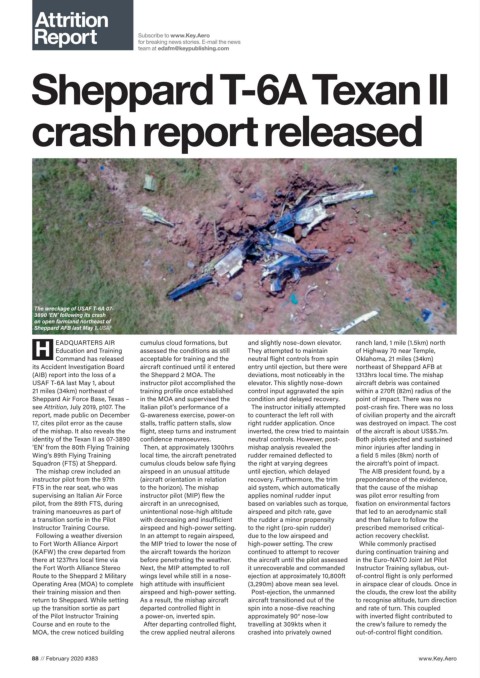
              The wreckage of USAF T-6A 07-
              3890 ‘EN’ following its crash
              on open farmland northeast of
              Sheppard AFB last May 1. USAF
              H    EADQUARTERS AIR      cumulus cloud formations, but   and slightly nose-down elevator.   ranch land, 1 mile (1.5km) north
                   Education and Training
                                                                                              of Highway 70 near Temple,
                                                                   They attempted to maintain
                                        assessed the conditions as still
                   Command has released   acceptable for training and the   neutral flight controls from spin   Oklahoma, 21 miles (34km)
              its Accident Investigation Board   aircraft continued until it entered   entry until ejection, but there were   northeast of Sheppard AFB at
              (AIB) report into the loss of a   the Sheppard 2 MOA. The   deviations, most noticeably in the   1313hrs local time. The mishap
              USAF T-6A last May 1, about   instructor pilot accomplished the   elevator. This slightly nose-down   aircraft debris was contained
              21 miles (34km) northeast of   training profile once established   control input aggravated the spin   within a 270ft (82m) radius of the
              Sheppard Air Force Base, Texas –   in the MOA and supervised the   condition and delayed recovery.   point of impact. There was no
              see Attrition, July 2019, p107. The   Italian pilot’s performance of a   The instructor initially attempted   post-crash fire. There was no loss
              report, made public on December   G-awareness exercise, power-on   to counteract the left roll with   of civilian property and the aircraft
              17, cites pilot error as the cause   stalls, traffic pattern stalls, slow   right rudder application. Once   was destroyed on impact. The cost
              of the mishap. It also reveals the   flight, steep turns and instrument   inverted, the crew tried to maintain  of the aircraft is about US$5.7m.
              identity of the Texan II as 07-3890   confidence manoeuvres.  neutral controls. However, post-  Both pilots ejected and sustained
              ‘EN’ from the 80th Flying Training   Then, at approximately 1300hrs   mishap analysis revealed the   minor injuries after landing in
              Wing’s 89th Flying Training   local time, the aircraft penetrated   rudder remained deflected to   a field 5 miles (8km) north of
              Squadron (FTS) at Sheppard.  cumulus clouds below safe flying   the right at varying degrees   the aircraft’s point of impact.
              The mishap crew included an   airspeed in an unusual attitude   until ejection, which delayed   The AIB president found, by a
              instructor pilot from the 97th   (aircraft orientation in relation   recovery. Furthermore, the trim   preponderance of the evidence,
              FTS in the rear seat, who was   to the horizon). The mishap   aid system, which automatically   that the cause of the mishap
              supervising an Italian Air Force   instructor pilot (MIP) flew the   applies nominal rudder input   was pilot error resulting from
              pilot, from the 89th FTS, during   aircraft in an unrecognised,   based on variables such as torque,  fixation on environmental factors
              training manoeuvres as part of   unintentional nose-high altitude   airspeed and pitch rate, gave   that led to an aerodynamic stall
              a transition sortie in the Pilot   with decreasing and insufficient   the rudder a minor propensity   and then failure to follow the
              Instructor Training Course.   airspeed and high-power setting.   to the right (pro-spin rudder)   prescribed memorised critical-
              Following a weather diversion   In an attempt to regain airspeed,   due to the low airspeed and   action recovery checklist.
              to Fort Worth Alliance Airport   the MIP tried to lower the nose of   high-power setting. The crew   While commonly practised
              (KAFW) the crew departed from   the aircraft towards the horizon   continued to attempt to recover   during continuation training and
              there at 1237hrs local time via   before penetrating the weather.   the aircraft until the pilot assessed  in the Euro-NATO Joint Jet Pilot
              the Fort Worth Alliance Stereo   Next, the MIP attempted to roll   it unrecoverable and commanded   Instructor Training syllabus, out-
              Route to the Sheppard 2 Military   wings level while still in a nose-  ejection at approximately 10,800ft   of-control flight is only performed
              Operating Area (MOA) to complete  high attitude with insufficient   (3,290m) above mean sea level.  in airspace clear of clouds. Once in
              their training mission and then   airspeed and high-power setting.   Post-ejection, the unmanned   the clouds, the crew lost the ability
              return to Sheppard. While setting   As a result, the mishap aircraft   aircraft transitioned out of the   to recognise altitude, turn direction
              up the transition sortie as part   departed controlled flight in   spin into a nose-dive reaching   and rate of turn. This coupled
              of the Pilot Instructor Training   a power-on, inverted spin.   approximately 90° nose-low   with inverted flight contributed to
              Course and en route to the   After departing controlled flight,   travelling at 309kts when it   the crew’s failure to remedy the
              MOA, the crew noticed building   the crew applied neutral ailerons   crashed into privately owned   out-of-control flight condition.


              88 // February 2020 #383                                                                        www.Key.Aero


                                                                                                                06/01/2020   09:20:49
        88-91 Attrition AFM Feb2020.indd   88                                                                   06/01/2020   09:20:49
        88-91 Attrition AFM Feb2020.indd   88

