


Page 139 - (DK Eyewitness) Travel Guide - Belgium & Luxembourg
P. 139
GHENT 137
fruit and cartouches. The earliest
building in this embankment is
the 12th-century Spijker (Staple
House). This simple Romanesque
struc ture stored the city’s grain
supply for hundreds of years
until a fire destroyed its interior.
Facing the Graslei across the
water, the gabled buildings
of the Korenlei date from
later centuries, but gracefully
com plement the architecture
of the Graslei. The views of
the city’s iconic buildings
from St-Michielsbrug, the
bridge at the southern end,
crossing the River Leie, are
among the most beautiful
in Ghent.
E Design Museum Gent
Jan Breydelstraat 5. Tel (09) 2679999.
Open 10am–6pm Tue–Sun. &
∑ design museumgent.be
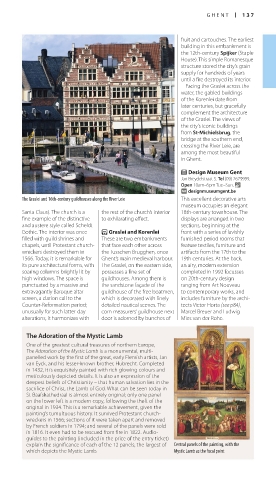
The Graslei and 16th-century guildhouses along the River Leie This excellent decorative arts
museum occupies an elegant
Santa Claus). The church is a the rest of the church’s interior 18th-century town house. The
fine example of the distinctive to exhilarating effect. displays are arranged in two
and austere style called Scheldt sections, begin ning at the
Gothic. The interior was once P Graslei and Korenlei front with a series of lavishly
filled with guild shrines and These are two embankments fur nished period rooms that
chapels, until Protestant church- that face each other across feature textiles, furniture and
wreckers destroyed them in the Tusschen Brugghen, once artifacts from the 17th to the
1566. Today, it is remarkable for Ghent’s main medieval har bour. 19th centuries. At the back,
its pure archi tectural forms, with The Graslei, on the eastern side, an airy, modern extension
soaring columns brightly lit by possesses a fine set of completed in 1992 focusses
high windows. The space is guildhouses. Among them is on 20th-century design
punc tuated by a massive and the sandstone façade of the ranging from Art Nouveau
extravagantly Baroque altar guildhouse of the free boatmen, to contemporary works, and
screen, a clarion call to the which is decorated with finely includes furniture by the archi-
Counter-Reformation period; detailed nautical scenes. The tects Victor Horta (see p84),
unusually for such latter-day corn measurers’ guildhouse next Marcel Breuer and Ludwig
alterations, it harmonizes with door is adorned by bunches of Mies van der Rohe.
The Adoration of the Mystic Lamb
One of the greatest cultural treasures of northern Europe,
The Adoration of the Mystic Lamb is a monumental, multi-
panelled work by the first of the great, early Flemish artists, Jan
van Eyck, and his lesser-known brother, Hubrecht. Completed
in 1432, it is exquisitely painted with rich glow ing colours and
meticulously depicted details. It is also an expression of the
deepest beliefs of Christianity – that human salvation lies in the
sacrifice of Christ, the Lamb of God. What can be seen today in
St-Baafskathedraal is almost entirely original; only one panel
on the lower left is a modern copy, following the theft of the
original in 1934. This is a remar k able achievement, given the
paint ing’s tumultuous history. It survived Protestant church-
wreckers in 1566; sections of it were taken apart and removed
by French soldiers in 1794; and several of the panels were sold
in 1816. It even had to be rescued from fire in 1822. Audio-
guides to the painting (included in the price of the entry ticket)
explain the significance of each of the 12 panels, the largest of Central panels of the painting, with the
which depicts the Mystic Lamb. Mystic Lamb as the focal point
136-137_EW_Belgium.indd 137 18/10/16 3:01 pm

