


Page 43 - (DK Eyewitness) Travel Guide - Belgium & Luxembourg
P. 43
INTRODUCING BEL GIUM AND L UXEMBOURG 41
THE HISTORY OF
BELGIUM
Both a young country and a very old one, Belgium won independence
for the first time in 1830, but owes its name to Gallic tribes who confronted
the Romans in 58 BC. Its location on the crossroads of northern Europe
made it both a hub of inter national trade and the battlefield for contending
nations. Today, its position has brought new benefits, at the heart of
the European Union.
When Julius Caesar set out to conquer Louis the German, as King of East Francia,
the Gauls of western Europe in 58 BC, took the southern portion called Lotharingia
he encountered a fierce group of tribes (Lorraine). This included the Walha (later,
there, known as the Belgae. Roman the Walloons) – Romanized Celts who
victory in the region led to the occu pied the Meuse valley. Charles
establishment of the province of Gallia the Bald, King of West Francia, took the
Belgica. Following the collapse of the western portion, which encom passed a
Roman Empire in the 5th century, the large chunk of Flanders. The French claim
Germanic Franks came to power here, to Flanders would haunt the region for
initially making Tournai, in modern-day the next 600 years.
Wallonia, their capital. The Frankish ruler
Clovis I established the Merovingian Flourishing Trade
dynasty (AD 481–751), whose empire From about 1100 onwards, a number of
soon encompassed all of Gaul. During this fortified trading cities developed on inland
time, Christianity was spread across the waterways. Flanders became the focus
land by missionaries such as the French of the cloth trade, weaving high-quality
saint Eligius in Flanders. The Merovingians wool imported from England into valuable
were followed by the Carolingian dynasty textiles and tapestries. By the late
(751–987), which produced one of the medieval period (14th century), trade
most important figures of the Middle routes led to France, Germany and Spain,
Ages – Charlemagne, who extended his and over the Alps to Renaissance Italy.
borders to cover most of western Europe Belgian towns such as Brussels, Ghent,
and was crowned by the pope as Emperor Ypres, Antwerp and Bruges became
of the West. After Charlemagne’s death, famous for their wealth and luxury. Their
the empire was divided up among his elaborate town halls, belfries and market
grandsons, and the province of Belgium squares were physical symbols of their
was split along the River Scheldt. wealth, pride and sense of independence.
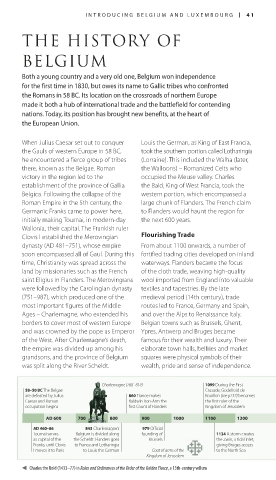
Charlemagne (768–814) 1099 During the First
58–50 BC The Belgae Crusade, Godefroid de
are defeated by Julius 860 France makes Bouillon (see p237) becomes
Caesar and Roman Baldwin Iron-Arm the the first ruler of the
occupation begins first Count of Flanders Kingdom of Jerusalem
AD 600 700 800 900 1000 1100 1200
AD 460–86 843 Charlemagne’s 979 Official
Tournai serves Belgium is divided along founding of 1134 A storm creates
as capital of the the Scheldt: Flanders goes Brussels the Zwin, a tidal inlet,
Franks, until Clovis to France and Lotharingia giving Bruges access
I moves it to Paris to Louis the German Coat of arms of the to the North Sea
Kingdom of Jerusalem
Charles the Bold (1433–77) in Rules and Ordinances of the Order of the Golden Fleece, a 15th-century vellum
040-041_EW_Belgium.indd 41 18/10/16 3:00 pm

