


Page 52 - (DK Eyewitness) Travel Guide - Belgium & Luxembourg
P. 52
50 INTRODUCING BEL GIUM AND L UXEMBOURG
Consolidating the New State associated with the social deprivation
In Belgium’s early days as an independent that came with industrialization. Equally
nation, Brussels was a haven for free- controversial was his acquisition of the
thinkers such as the libertarian poet Congo in Africa and the abuses of colonial
Baudelaire, and a refuge for exiles such as power that were played out there.
Karl Marx and Victor Hugo. In 1799, steam
power was brought to the textile industry The German Occupations
at Verviers, in Eastern Wallonia, and Belgium Like much of Europe, Belgium was enjoying
began following in the tracks of Britain. It a belle époque before the calamities of the
was now industrializing fast. Continental 20th century began to unfold. In the summer
Europe’s first railway line opened in 1835 of 1914, it was invaded by the German army.
between Brussels and Mechelen and by Although Belgium had been created as
1870, there were four main railway stations a neutral country, some of the bloodiest
in Brussels that exported goods all over battles of World War I were staged on its
Europe. By this time, the focus of industrial soil. The front line followed a southward path
development was Wallonia, with its coal through the marginally higher land around
mines and iron industries. This reinforced Ypres (Ieper). The opposing armies dug in
the age-old supremacy of French-speaking and suffered years of brutal trench warfare in
Belgians. Dutch-speaking Flanders a stalemate that cost nearly a million lives.
remained largely rural, impoverished and Today, the peaceful agricultural land on
increasingly resentful of the imposition of either side of the salient is spattered with
French by the ruling elite – French was the military cemeteries filled with the foreign
language of administration, education, law soldiers who came here to contest the
and intellectual life. Western Front.
The long reign of Belgium’s second While the Belgian army, led by King Albert I
monarch, Léopold II (r.1865–1909), spanned (r.1909–34), put up a spirited resistance from
the rapid development of Belgium. He their last stronghold in De Panne in the far
was praised for his vision, but was also northwest, most of the rest of the country
remained under occupation –
often brutal and vindictive – until
the last day of the war, 11 November
1918. The 1919 Treaty of Versailles
granted Belgium control of
Eupen-Malmedy, the German-
speaking area in the east.
In 1940, neutral Belgium was
invaded again by the Germans
under Hitler. Many Belgians took
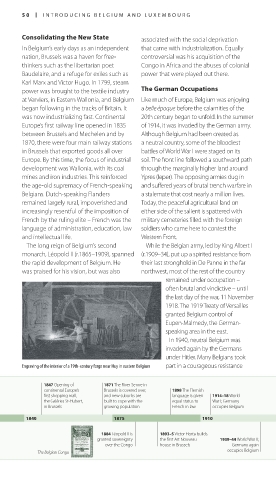
Engraving of the interior of a 19th-century forge near Huy in eastern Belgium part in a courageous resistance
1847 Opening of 1871 The River Senne in
continental Europe’s Brussels is covered over, 1898 The Flemish
first shopping mall, and new suburbs are language is given 1914–18 World
the Galéries St-Hubert, built to cope with the equal status to War I; Germany
in Brussels growing population French in law occupies Belgium
1840 1875 1910
1884 Léopold II is 1893–5 Victor Horta builds
granted sovereignty the first Art Nouveau 1939–44 World War II;
over the Congo house in Brussels Germany again
The Belgian Congo occupies Belgium
050-051_EW_Belgium.indd 50 18/10/16 2:56 pm

