


Page 38 - (DK Eyewitness) Travel Guide - Tokyo
P. 38
36 T OK Y O AREA B Y AREA
Tokyo at a Glance
Japan’s capital is situated on the banks of the Sumida River,
by Tokyo Bay. As the fishing village of Edo it became the
shogunate’s center of power in 1603. The Shitamachi (low city)
of merchants and artisans served the political and intellectual
elite in the Yamanote (high city) on the hills to the west.
Renamed Tokyo and made capital in 1868, the city was
devastated by the Great Kanto Earthquake of 1923, followed
TOKYO
by World War II bombing. It has since reinvented itself as one
of the world’s most modern, exciting, and energizing cities.
Transportation is efficient – the easy-to-use JR Yamanote Line
circles the city, subway lines crisscross the center (see Back End-
paper), and shinkansen lines link it with the rest of the country.
It can be difficult to find individual buildings by their addresses Locator Map
(see p171). The Tokyo Street Finder (see pp176–85) locates all
the sights, restaurants, and hotels mentioned in this guide.
NORTHERN
NO.1 (See pp48–59)
TOKYO
EXPRESSWAY
West Shinjuku (see pp64–5) is an area of SHINJUKU-D O R I EXPRES SWAY N O . 9
soaring skyscrapers, providing a visible
manifestation of the corporate wealth of EXPRESSWAY N O . 4
Tokyo. The most impressive buildings are CENTRAL TOKYO
the Tokyo Metropolitan Government (See pp38–47)
Offices, designed by Kenzo Tange. WESTERN TOKYO
(See pp60–71) DORI
AOYAMA-DORI EXPRESS WAY NO.3 SAKURADA
E X PRESSWA Y N O . 1
East Shinjuku
(see pp62–3) comes
alive when West
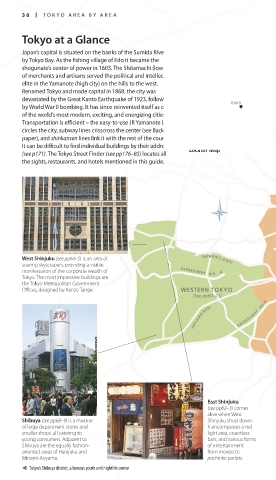
Shibuya (see pp68–9) is a mixture Shinjuku shuts down.
of large department stores and It encompasses a red-
smaller shops, all catering to light area, countless
young consumers. Adjacent to bars, and various forms
Shibuya are the equally fashion- of entertain ment
oriented areas of Harajuku and from movies to
Minami-Aoyama. pachinko parlors.
Tokyo’s Shibuya district, a famous youth and nightlife center
036-037_EW_Tokyo.indd 36 12/09/16 11:27 am

