


Page 9 - (DK Eyewitness) Travel Guide - Tokyo
P. 9
HOW T O USE THIS GUIDE 7
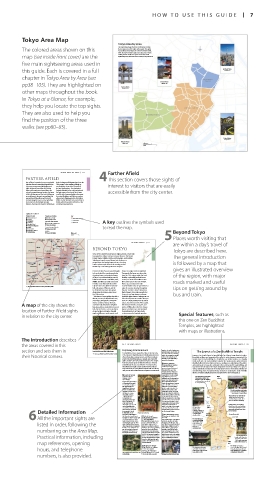
Tokyo Area Map
Tokyo Area by Area
The colored areas shown on this The map below shows the three central areas of Tokyo
that contain most of the sights in this guide. The sights
surrounding central Tokyo are covered in Farther Afield,
while the Beyond Tokyo chapter describes places worth
map (see inside front cover) are the visiting that lie outside the capital. Each of the main
sightseeing areas has been color-coded for easy reference.
five main sightseeing areas used in
this guide. Each is covered in a full Northern Tokyo
Pages 48–59
chapter in Tokyo Area by Area (see
TOKYO
Beyond Tokyo NORTHERN
pp38–105). They are highlighted on Farther Afield Pages 86–105
other maps throughout the book. Pages 72–79
In Tokyo at a Glance, for example,
they help you locate the top sights. CENTRAL TOKYO
They are also used to help you WESTERN TOKYO
find the position of the three
walks (see pp80–85).
Central Tokyo
Pages 38–47
Western Tokyo
Pages 60–71 0 kilometers 1
0 miles 1
Tokyo
T OK Y O AREA B Y AREA 73 Farther Afield
FARTHER AFIELD 4This section covers those sights of
Due to Tokyo’s expansion in every conceivable shrine in downtown Fukagawa dates from the
dir ection, the area around the Imperial Palace 17th century. To the northwest, Rikugi-en, interest to visitors that are easily
is just one among several widely dispersed near Ikebukuro, is one of the Edo period’s
sights of interest around the city. Seeking last great stroll gardens. The atmospheric
them out, though, poses few problems in a Sengaku-ji temple, in the south, reconstructs
city with a superb transport system. The Japan the final scenes in the story of the 47 ronin, accessible from the city center.
Folk Crafts Museum and the Goto Art Museum a real-life tale of samurai loyalty and revenge.
are small gems in pleasant surroundings that In contrast, Ikebukuro and Ebisu are modern
give an idea of Tokyo life as well as its rich urban centers. Daikanyama, the chic fashion
heritage. Ryogoku, home to sumo wrestling, district, and the futuristic man-made island of
also features the fascinating Edo-Tokyo Odaiba, with its innovative architecture, offer
Museum. The impressive Tomioka Hachiman-gu a contemporary experience.
Sights at a Glance
Notable Districts Temples and Shrines Key
1 Ikebukuro District 5 Gokoku-ji Temple Main sightseeing area
2 Sugamo q Sengaku-ji Temple Expressway
3 Komagome Museums and Galleries Main road A key outlines the symbols used
6 Zoshigaya r Japan Folk Crafts Museum
7 Ryogoku District y Goto Art Museum
8 Downtown Fukagawa
0 Odaiba Scenic Transport Routes to read the map.
w Ebisu District 4 Arakawa Tram Line
e Daikanyama District Markets
t Shimokitazawa Beyond Tokyo
9 Toyosu Fish Market 0 km 1.5
0 miles 1.5
TOSHIMA- Ikebukuro Sugamo 5Places worth visiting that
Shimoigusa KU BEY OND T OK Y O 87
TAITO-KU are within a day’s travel of
BUNKYO-KU Ueno
Nakano
Asakusa SUMIDA-KU BEYOND TOKYO
NAKANO-KU SHINJUKU-KU Tokyo are described here.
Ryogoku
Shinjuku Some of the country’s most famous sights are just a short train
Kanda
Yoyogi Kiyosumi trip away from Tokyo. Foremost among these are the historic The general introduction
Minamidai CHIYODA-KU temple towns of Nikko, Narita, and Kamakura, and bustling
KOTO-KU Yokohama, Japan’s second-largest city. Hakone is a
Akasaka Ginza
CHUO EXPR ESSWAY SHIBUYA-KU CHUO-KU Toyo mountainous hot-spring town and on a clear day, is followed by a map that
Shibuya Roppongi it offers picturesque views of the soaring peak of
Akatsutsumi Shimbashi Mount Fuji – one of the great icons of Japan.
MINATO-KU Harumi gives an illustrated overview
SETAGAYA-KU Ebisu It takes less time than one would imagine shops. The origins of the magnificent
to leave behind the sprawling suburbs,
Tsurugaoka Hachiman-gu shrine date
TOMEI EXPRESSWAY MEGURO-KU dormitory towns, and industrial fringes from the 11th century, while the Great of the region, with major
of Tokyo to reach breathtaking natural Buddha, a splendidly realized bronze
Nakamachi Odaiba
Himonya
Kaminoge Tairamachi habitats and environs. Fine hiking trails, statue, has survived from when it was roads marked and useful
wildlife, and flora are easily accessed at
first cast in 1252. To the east of Tokyo,
Chichibu-Tama National Park and the Narita-san, an important temple
The suspended titanium dome at the Fuji TV Building, Odaiba Fuji Five Lakes area, while the volcanic associated with Fudo, the god of fire, is a
hills and gorges of Hakone and the place of common worship throughout tips on getting around by
Izu Peninsula have been hot-spring the year. Located a stone’s throw from
destinations for foreign visitors since Narita Airport, this temple provides the
the 19th century. chance to see how Japanese observe bus and train.
Yokohama, a cosmopolitan city with a their faith, right down to having new cars
vibrant port area, delightful museums, blessed and protective amulets hung on
and a large, atmospheric Chinatown them, in a ritual presided over by robed
A map of the city shows the district combines history, ethnicity, priests. Just an hour north of the capital,
and modernity. Yokohama’s neighbor
the elaborate shrines, rand gates, and
tombs of Nikko, where the first shogun
Kamakura, sitting snugly between green
location of Farther Afield sights hills and the Pacific, is a treasure-house Ieyasu is enshrined, are overshadowed
by towering forests of cryptomeria,
of spectacular Zen temples, tranquil
in relation to the city center. gardens, teahouses, and exquisite craft creating a mood of spiritual grandeur. Special features, such as
this one on Zen Buddhist
Temples, are highlighted
with maps or illustrations.
The introduction describes
the areas covered in this 94 BEY OND T OK Y O BEY OND T OK Y O 95
section and sets them in A row of Buddhist statues, Nikko, Tochigi prefecture Exploring Kita Kamakura gardens. As well as hydrangeas The Layout of a Zen Buddhist Temple
(at their peak in June), there are
Zen Buddhism came to Japan from China at the end of the
their historical context. Snow-capped Mount Fuji and the Fuji-Hakone-Izu National Park 12th century. Its simplicity and accessibility appealed to the irises; these bloom in late May, Japanese Zen temple layout is typically based on Chinese Sung-dynasty tem ples.
when the rear garden, usually
ethos of Kamakura samurai warriors as well as to ordi nary
only tantalizingly glimpsed
Essentially rectilinear and symmetrical (in contrast to native Japanese asym metry), Zen
people. Kita (north) Kamakura, a tranquil area of wooded through a round win dow, is temples have the main buildings in a straight line one behind another, on a roughly
opened to the public.
gullies, includes three of Kama kura’s five great Zen temples – north-south axis. The main buildings comprise the Sanmon (main gate), Butsuden
Kencho-ji, Engaku-ji, and Jochi-ji (the others are Jomyo-ji Kencho-ji Temple (Buddha Hall), Hatto lecture hall, sometimes a meditation or study hall, and the abbot’s
and Jufuku-ji). The area is served by its own train station, £ Kita Kamakura stn. Tel (0467) and monks’ quarters. In practice, sub temples often crowd around the main buildings and
from which most sights can be reached on foot. Delicate 22-0981. Open daily. & may obscure the basic layout. The temple compound is entered by a bridge over a pond or
vegetarian food (see p119), which complies with Zen dietary Kencho-ji is the foremost of stream, symbolically crossing from the earthly world to that of the Buddha. Buildings are
rules, can be tried at Kita Kamakura temples and restaurants. Kamakura’s five great Zen natural looking, often of unpainted wood, conducive to emptying the mind of worldly
temples and the oldest Zen illusions, to facilitate enlighten ment. The example below is based on Engaku-ji.
training monastery in Japan.
Engaku-ji Temple Founded in 1253, the temple
£ Kita Kamakura stn. originally had seven main The Shariden, in Shozoku-in Obai-in
Tel (0467) 22-0478. buildings and 49 subtemples; subtemple, enshrines the subtemple
Open daily. & many were destroyed in fires, Buddha’s tooth. The building
Deep in trees, the largest but 10 subtemples remain. is a National Treasure due to
its Zen architecture.
of Kama kura’s five great Beside the impressive Sanmon
Zen temples, Engaku-ji gate is the bell, cast in 1255,
was founded by the which has a Zen inscription
Hojo regent Tokimune by the temple’s founder. The
in 1282. An influential Buddha Hall contains a Jizo The Butsunichian subtemple
medi tation center since bodhisattva, savior of souls of is the mausoleum of Tokimune
the Meiji era, it now the dead. Behind the hall is the and contains a statue of him.
runs public courses. Hatto, where public cere monies
Although much are performed. The Karamon Pond The Daiho-jo was formerly the
abbot’s quarters and is now
of Engaku-ji was (Chinese gate) leads to the Hojo, used for religious rituals. Next
destroyed by the 1923 used for services. Its rear garden to it are a kitchen and library.
Kanto Earthquake, 17 is constructed around a pond
of its more than 40 supposedly in the shape of the
subtemples remain, and kanji character for heart or Juniper trees are sometimes
careful re building has mind. To the side of the temple Gravel planted near the main buildings
ensured that it retains its a tree-lined lane leads to sub- The Butsuden garden and are often grown from seeds
(Buddha Hall)
supposedly brought from China
charac teristic Zen layout
temples and up steps to Hanso-
Detailed Information (see opposite). One of Bosatsu statue at Kencho-ji bo, the temple’s shrine. contains an image of Former Hatto by the founder.
the Buddha. The hall
its highlights, in the
at Engaku-ji was
Karamon (Chinese gate)
the Shariden. Japan’s finest
6All the important sights are Shozoku-in subtemple, is Tokei-ji Temple Zeni-Arai Benten Shrine rebuilt in 1964. (lecture hall) Former bath
£ Kamakura stn. Tel (0467) 25-1081.
Open daily.
£ Kita Kamakura stn. Tel (0467)
example of Chinese Sung-style
Zen archi tecture, it is open
The Senbutsu-jo is
22-1663. Open daily. &
This popular shrine is dedi cated
only at New Year but can be This quiet little temple was set to Benten, goddess of music, a thatched building
listed in order, following the seen through a gate at other up as a convent in 1285, at a eloquence, and the arts, and to be ordained. It
where priests used
one of the “seven lucky gods” of
time when only men were
times. Farther on, the Butsuni-
now occasion ally
allowed to petition for divorce.
folk religion. Hidden in a niche
chian, mauso leum of Engaku-ji’s
serves as a
numbering on the Area Map. founder, serves matcha tea. It However, if a woman spent three in the cliffs, it is approached meditation hall.
through a small tunnel and a
years here she could divorce
was the setting for Yasunari
Kawabata’s 1949 novel Sen
her husband. Thus Tokei-ji was
row of torii (gates). These lead
to a pocket of wafting incense,
nicknamed the “divorce temple.”
bazuru (Thousand Cranes).
Practical information, including In 1873 the law was changed to lucky charms, and a cave spring Archery Engaku-ji, the largest in
The temple bell at
where visitors wash coins in the
allow women to initiate divorce;
hope of doubling their value.
in 1902 Tokei-ji became a mona-
stery. It is still refuge-like, with hall Kamakura, dates from
1301 and is now rung
map references, opening wooded hillside. Somon (gate) The bridge to Engaku-ji
gardens stretching back to the
only on New Year’s Eve.
Meigetsu-in Temple
hours, and telephone £ Kita Kamakura stn. Tel (0467) The Sanmon is the main crosses the White Heron pond.
The path also crosses the rail
gate. Made of wood and
24-3437. Open daily. &
track, doubling the symbolism
held together without nails,
Known as the “hydrangea
Stone monuments in the peaceful cemetery temple,” Meigetsu-in is a small it was built in 1783. of leaving the real world.
numbers, is also provided. at Tokei-ji temple Zen temple with attractive Washing coins at Zeni-Arai Benten shrine
006-007_EW_Tokyo.indd 7 12/09/16 11:23 am

