


Page 43 - Sports Illustrated KIDS Magazine (January - February 2020)
P. 43
AS CONFUSING AS THAT SCENARIO IS, it might have been our reality if
                                                                 a Hungarian soccer player named Pete Gogolak had not joined Cornell
                                                                 University’s football team in the fall of 1961. Really! I can explain!
                                                                    Let’s start with our fictional Oilers’ decision to go for it. Kicking used
                                                                 to be a much less certain proposition than it is now. Last season, NFL
                                                                 kickers made 84.7% of all field goals. They attempted 152 from at least 50
                                                                 yards, of which they hit 97. The season before Gogolak went pro—1963—
                                                                 teams made less than half their field goals. They only tried six kicks from
                                                                 beyond 50 yards.
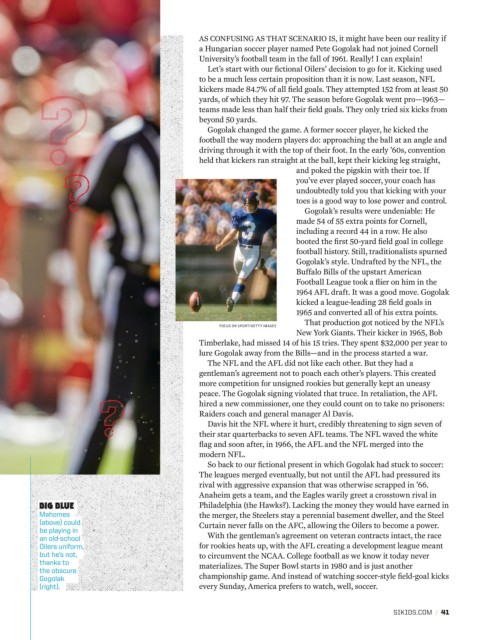
                                                                    Gogolak changed the game. A former soccer player, he kicked the

                                                                 football the way modern players do: approaching the ball at an angle and
                                                                 driving through it with the top of their foot. In the early ’60s, convention
                                                                 held that kickers ran straight at the ball, kept their kicking leg straight,
                                                                                                and poked the pigskin with their toe. If
                                                                                                you’ve ever played soccer, your coach has
                                                                                                undoubtedly told you that kicking with your
                                                                                                toes is a good way to lose power and control.
                                                                                                   Gogolak’s results were undeniable: He
                                                                                                made 54 of 55 extra points for Cornell,
                                                                                                including a record 44 in a row. He also
                                                                                                booted the first 50-yard field goal in college
                                                                                                football history. Still, traditionalists spurned
                                                                                                Gogolak’s style. Undrafted by the NFL, the
                                                                                                Buffalo Bills of the upstart American
                                                                                                Football League took a flier on him in the
                                                                                                1964 AFL draft. It was a good move. Gogolak
                                                                                                kicked a league-leading 28 field goals in
                                                                                                1965 and converted all of his extra points.
                                                                                                   That production got noticed by the NFL’s
                                                                        FOCUS ON SPORT/GETTY IMAGES
                                                                                                New York Giants. Their kicker in 1965, Bob
                                                                 Timberlake, had missed 14 of his 15 tries. They spent $32,000 per year to
                                                                 lure Gogolak away from the Bills—and in the process started a war.
                                                                    The NFL and the AFL did not like each other. But they had a
                                                                 gentleman’s agreement not to poach each other’s players. This created
                                                                 more competition for unsigned rookies but generally kept an uneasy

                                                                 peace. The Gogolak signing violated that truce. In retaliation, the AFL
                                                                 hired a new commissioner, one they could count on to take no prisoners:
                                                                 Raiders coach and general manager Al Davis.
                                                                    Davis hit the NFL where it hurt, credibly threatening to sign seven of
                                                                 their star quarterbacks to seven AFL teams. The NFL waved the white
                                                                 flag and soon after, in 1966, the AFL and the NFL merged into the
                                                                 modern NFL.
                                                                    So back to our fictional present in which Gogolak had stuck to soccer:
                                                                 The leagues merged eventually, but not until the AFL had pressured its
                                                                 rival with aggressive expansion that was otherwise scrapped in ’66.
                                                                 Anaheim gets a team, and the Eagles warily greet a crosstown rival in
                                                                 Philadelphia (the Hawks?). Lacking the money they would have earned in

              Mahomes                                            the merger, the Steelers stay a perennial basement dweller, and the Steel
              (above) could                                      Curtain never falls on the AFC, allowing the Oilers to become a power.
              be playing in
              an old-school                                         With the gentleman’s agreement on veteran contracts intact, the race
              Oilers uniform,                                    for rookies heats up, with the AFL creating a development league meant
              but he’s not,                                      to circumvent the NCAA. College football as we know it today never
              thanks to                                          materializes. The Super Bowl starts in 1980 and is just another
              the obscure
              Gogolak                                            championship game. And instead of watching soccer-style field-goal kicks
              (right).                                           every Sunday, America prefers to watch, well, soccer.


                                                                                                                                SIKIDS.COM  /  41

