


Page 61 - Forbes - USA (February 2018)
P. 61
SPECIAL ADVERTISTING SECTION


                                                 THK:


        BOOSTING GROWTH CAPACITY THROUGH AI AND ROBOTICS


          Akihiro Teramachi, Chief Executive Officer and President of THK Co., Ltd, is looking to increase his company’s
          growth capacity by leveraging Artificial Intelligence (AI) and robotics in the face of a shrinking labor market.


        THK, the company that pioneered the Linear   China and Vietnam to maximize production   need to develop human resources capable
        Motion Guide mechanism, has also relocated   in response to soaring demand driven by the   of qualifying for this high-income group at
        its head office to strengthen group-wide   rise of the Internet of Things (IoT), the auto-  THK, even while society becomes polarized,”
        cooperation, improve operational efficiency,   mobile industry, and also as a result of the   he says.
        and enhance business continuity planning. In   automation of production facilities.
        addition, the company is investing in Japan,   “We have our hands full just keeping up  Changing Minds
                                           with demand,” says Teramachi. “In addition   Education, training and self-awareness are
                                           to the spread of IoT, semiconductor-related   vital in this process, but one hurdle is that
                                           investment is expanding as a result of the   the global education system continues to
                                           increase in electric vehicles and advances in   revolve around the idea that humans are irre-
                                           self-driving technologies. We are also see-  placeable. Teramachi believes it is essential
                                           ing increased overall demand for our prod-  for people to be able to adapt to changes
                                           ucts given the steady growth in investment   in society and the environment, and that we
                                           related to the automation of production facil-  must develop an education system that sup-
                                           ities against a backdrop of labor shortages.”  ports this.
                                                                               “The good thing about the Japanese is that
                                           Brave New World                   they are a close-knit, homogenous and duti-
                                           Teramachi has triggered a major change in   ful society, which is extremely useful when it
                                           the company’s business style driven by AI,   comes to ensuring quality and safety. On the
                                           robotics and IoT as the third strategic pillar   other hand, these qualities can also impede
                                           for THK. The challenge is to develop products   the launching of, and reactions to, change.
                                           that match changing needs, and to simulta-  If the Japanese education system can be
                                           neously consider sales-based uses and other   steered towards providing pupils with a
                                           applications.                     sense of independence and self-respect,
                                            And yet, Teramachi is wary of over-reliance   along with a healthy appreciation for change
                                           on AI and robotics. “If we allow robots to pen-  while maintaining its other positive points,
                                           etrate society in their existing format, they   then there is a good chance it can develop
                                           will not be in a position to purchase goods or   students capable of guiding global society in
                                           services, leading to shrinking consumption,   a better direction,” Teramachi says.
                                           smaller markets, and an atrophied economy.
                                           In addition, humans would lose their position
                                           in the workplace. We must avoid this state of
                                           affairs,” he says.
                                            “Looking ahead, humans must actively
                                           trust their work to AI and robotics, and focus
                                           their efforts on high-value-added creative
                                           work in other areas where this is not possible,
                                           such as anticipating needs that others cannot
                                           see. The 10,000-plus employees of the THK
                                           Group may be forced to alter the way they
                                           perform their jobs,” Teramachi says.
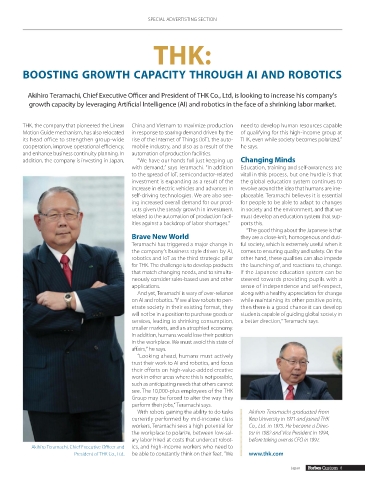
                                            With robots gaining the ability to do tasks   Akihiro Teramachi graduated from
                                           currently performed by mid-income class   Keio University in 1971 and joined THK
                                           workers, Teramachi sees a high potential for   Co., Ltd. in 1975. He became a Direc-
                                           the workplace to polarize, between low-sal-  tor in 1982 and Vice President in 1994,
                                           ary labor hired at costs that undercut robot-  before taking over as CEO in 1997.
           Akihiro Teramachi, Chief Executive Officer and   ics, and high-income workers who need to
                        President of THK Co., Ltd.  be able to constantly think on their feet. “We   www.thk.com

                                                                                             Japan          8

