


Page 6 - Flight International (January 2020)
P. 6
COMMENT


                                                                                   Moondust


                                                                                     y the end of this year or early next, we
                                                                                  Bshould get a look at the future of deep-
                                                                                  space travel. It will not carry a crew, but
                                                                                  NASA’s Artemis I around-the-Moon-and-
                                                                                  back flight will demonstrate the capsule,
                                                                                Andre Cros/Ville de Toulouse/Wikimedia Commons  tested to carry astronauts back to where
                                                                                  life-support system and mighty Space
                                                                                  Launch System rocket being designed and

                                                                                  they left off in 1972 with the final Apollo
                                                                                  mission.
                                                                                    The plan is then – on the orders of Pres-
                                                                                  ident Donald Trump – to press on and
                                                                                  will carry a human crew around the
                                                                                  Moon, and three or more Artemis support
        Still going strong                                                        land American boots by 2024. Artemis II
                                                                                  missions will deliver and assemble the
        Spin cycle                                                                Gateway space station, which will sit
                                                                                  most of the way to the Moon and serve as
                                                                                  jumping-off point for surface sorties.
                                                                                    Before we get too excited, we have been
        In the 2000s, the turboprop airliner seemed to have run its course, but now   here before. President George W Bush
        Embraer believes it is time customers were given more choice in the sector  aimed for a 2020 return – or maybe 2019
                                                                                  to mark the 50th anniversary of Apollo 11
                                                                                  – but his scheme was so far behind sched-
         f the stars align, the world could have the   was at a trickle. Only ATR and, ironically,   ule and over budget that Barack Obama,
        Ifirst all-new large turboprop passenger air-  Bombardier, kept the faith. In 2003, just 29 air-  taking office just as the financial crisis was
        craft for four decades within five years.   craft were delivered globally while over 300   really getting going, axed it.
          The irony is that this is the proposition   Bombardier and Embraer jets were shipped.  Trump’s Artemis vision has delivered
        from Embraer – a stalwart of jet-powered re-  But the props weren’t done. New technol-  a NASA budget explosion, to nearly $22
        gional aircraft that helped contribute to the   ogy like active noise control improved the   billion this year, but even a lot more
        near-extinction of the turboprop “race”.  passenger experience, while engine upgrades   money may not overcome the fact that
          Embraer’s case for a next-generation turbo-  enhanced performance. Bombardier created   critical components like Gateway and a
        prop airliner is a strong one – pointing to the   an enlarged Dash 8 that could carry 70-80   lander can at best be said to be in
        environmental and economic benefits, as   passengers at jet-like speeds. And the rising     development.
        well as the market disruption it could bring.   fuel price from around 2005 hit small-jet   If Trump is not re-elected, a new
          Today’s market leader, ATR, and its large-    economics hard.             president may be minded to spend bil-
        turboprop competitor, the De Havilland Can-                               lions restoring crumbling American infra-
        ada Dash 8 – along with smaller turboprops   Deliveries have averaged a   structure, educating children and fighting
        such as the Saab 340 and Embraer Brasilia –                               climate change rather than chasing moon-
        owned the regional sector for much of the  healthy 100 aircraft per year   dust. A second-term Trump may pivot to
        late 20th century.                                                        do the same, find himself grappling with
          That all changed in the mid-1990s, when a  during the 2010s, with ATR   recession or war, or even deciding that a
        modified Canadian business jet design with   the market leader             behind-schedule programme should be
        50 seats crashed their party. Embraer was                                 given more time – and left in a successor’s
        quick to identify the threat from the Bombar-                             in-tray. ■
        dier CRJ, and created its own 50-seater, the                               See News Focus P20
        ERJ. The two OEMs shipped 2,000 small re-  So the large turboprop sector bounced back
        gional jets between them from 1993 to 2005.  as the 50-seat jet era ended. Deliveries
          Their value proposition to regional opera-    averaged a healthy 100 aircraft per year during
        tors was compelling: big jet-like passenger   the 2010s, with ATR the market leader.
        experience, faster sector times and competi-  Embraer – a major player in the market
        tive economics.                      with its E-Jet series – believes the sector is
          Turboprop manufacturers were caught in a   ripe for disruption. It is confident it can cre-
        perfect storm, as the regional jet generation   ate a headache for the current turboprop
        arrived in tandem with a high-profile US tur-  players without diluting the market for its jet
        boprop accident – the infamous Roselawn   portfolio. The question is: will Embraer’s pro-
        tragedy in which 68 people died – combining   spective new partner Boeing have the appe-
        to effectively render obsolete the propeller-  tite to support such a venture? We won’t have               NASA
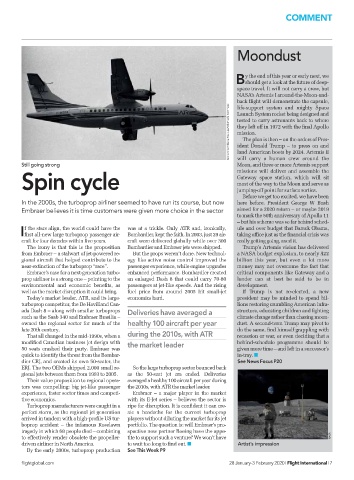
        driven airliner in North America.    to wait too long to find out. ■        Artist’s impression
          By the early 2000s, turboprop production   See This Week P9

        flightglobal.com                                                         28 January-3 February 2020  |  Flight International  |  7

