


Page 70 - Architectural Digest - USA (February 2020)
P. 70
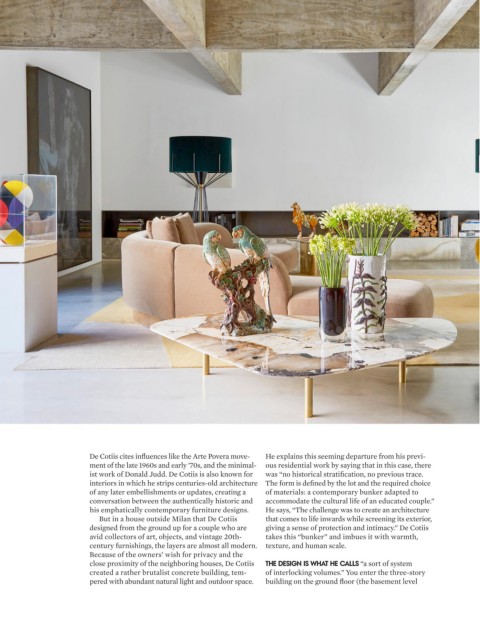
De Cotiis cites influences like the Arte Povera move-       He explains this seeming departure from his previ-
                                ment of the late 1960s and early ’70s, and the minimal-     ous residential work by saying that in this case, there
                                ist work of Donald Judd. De Cotiis is also known for        was “no historical stratification, no previous trace.
                                interiors in which he strips centuries-old architecture     The form is defined by the lot and the required choice
                                of any later embellishments or updates, creating a          of materials: a contemporary bunker adapted to
                                conversation between the authentically historic and         accommodate the cultural life of an educated couple.”
                                his emphatically contemporary furniture designs.            He says, “The challenge was to create an architecture
                                   But in a house outside Milan that De Cotiis              that comes to life inwards while screening its exterior,
                                designed from the ground up for a couple who are            giving a sense of protection and intimacy.” De Cotiis
                                avid collectors of art, objects, and vintage 20th-          takes this “bunker” and imbues it with warmth,
                                century furnishings, the layers are almost all modern.      texture, and human scale.
                                Because of the owners’ wish for privacy and the
                                close proximity of the neighboring houses, De Cotiis        THE DESIGN IS WHAT HE CALLS “a sort of system
                                created a rather brutalist concrete building, tem-          of interlocking volumes.” You enter the three-story
                                pered with abundant natural light and outdoor space.        building on the ground floor (the basement level

