


Page 84 - World of Animals - Issue #28 Magazine
P. 84
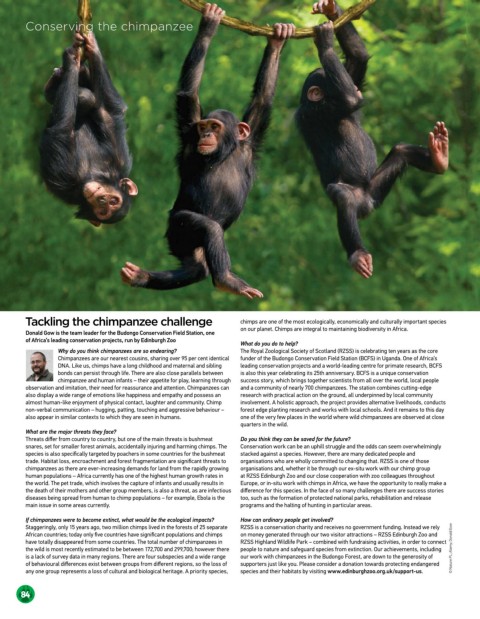
Conserving the chimpanzee


            Tackling the chimpanzee challenge                          chimps are one of the most ecologically, economically and culturally important species
                                                                       on our planet. Chimps are integral to maintaining biodiversity in Africa.
            Donald Gow is the team leader for the Budongo Conservation Field Station, one
            of Africa’s leading conservation projects, run by Edinburgh Zoo
                                                                       What do you do to help?
                     Why do you think chimpanzees are so endearing?    The Royal Zoological Society of Scotland (RZSS) is celebrating ten years as the core
                     Chimpanzees are our nearest cousins, sharing over 95 per cent identical   funder of the Budongo Conservation Field Station (BCFS) in Uganda. One of Africa’s
                     DNA. Like us, chimps have a long childhood and maternal and sibling   leading conservation projects and a world-leading centre for primate research, BCFS
                     bonds can persist through life. There are also close parallels between   is also this year celebrating its 25th anniversary. BCFS is a unique conservation
                     chimpanzee and human infants – their appetite for play, learning through   success story, which brings together scientists from all over the world, local people
            observation and imitation, their need for reassurance and attention. Chimpanzees can   and a community of nearly 700 chimpanzees. The station combines cutting-edge
            also display a wide range of emotions like happiness and empathy and possess an   research with practical action on the ground, all underpinned by local community
            almost human-like enjoyment of physical contact, laughter and community. Chimp   involvement. A holistic approach, the project provides alternative livelihoods, conducts
            non-verbal communication – hugging, patting, touching and aggressive behaviour –   forest edge planting research and works with local schools. And it remains to this day
            also appear in similar contexts to which they are seen in humans.  one of the very few places in the world where wild chimpanzees are observed at close
                                                                       quarters in the wild.
            What are the major threats they face?
            Threats differ from country to country, but one of the main threats is bushmeat   Do you think they can be saved for the future?
            snares, set for smaller forest animals, accidentally injuring and harming chimps. The   Conservation work can be an uphill struggle and the odds can seem overwhelmingly
            species is also specifically targeted by poachers in some countries for the bushmeat   stacked against a species. However, there are many dedicated people and
            trade. Habitat loss, encroachment and forest fragmentation are significant threats to   organisations who are wholly committed to changing that. RZSS is one of those
            chimpanzees as there are ever-increasing demands for land from the rapidly growing   organisations and, whether it be through our ex-situ work with our chimp group
            human populations – Africa currently has one of the highest human growth rates in   at RZSS Edinburgh Zoo and our close cooperation with zoo colleagues throughout
            the world. The pet trade, which involves the capture of infants and usually results in   Europe, or in-situ work with chimps in Africa, we have the opportunity to really make a
            the death of their mothers and other group members, is also a threat, as are infectious  difference for this species. In the face of so many challenges there are success stories
            diseases being spread from human to chimp populations – for example, Ebola is the   too, such as the formation of protected national parks, rehabilitation and release
            main issue in some areas currently.                        programs and the halting of hunting in particular areas.
            If chimpanzees were to become extinct, what would be the ecological impacts?  How can ordinary people get involved?
            Staggeringly, only 15 years ago, two million chimps lived in the forests of 25 separate   RZSS is a conservation charity and receives no government funding. Instead we rely
            African countries; today only five countries have significant populations and chimps   on money generated through our two visitor attractions – RZSS Edinburgh Zoo and
            have totally disappeared from some countries. The total number of chimpanzees in   RZSS Highland Wildlife Park – combined with fundraising activities, in order to connect
            the wild is most recently estimated to be between 172,700 and 299,700; however there   people to nature and safeguard species from extinction. Our achievements, including  © Nature PL; Alamy; Donald Gow
            is a lack of survey data in many regions. There are four subspecies and a wide range   our work with chimpanzees in the Budongo Forest, are down to the generosity of
            of behavioural differences exist between groups from different regions, so the loss of   supporters just like you. Please consider a donation towards protecting endangered
            any one group represents a loss of cultural and biological heritage. A priority species,   species and their habitats by visiting www.edinburghzoo.org.uk/support-us.

           84

