


Page 25 - Motor Trend (February 2020)
P. 25
NEWS I OPINION I GOSSIP I STUFF

           Frank Markus


           Technologue


          Future Tech: Lamborghini’s


          e-Hypercar Inches Toward Viability


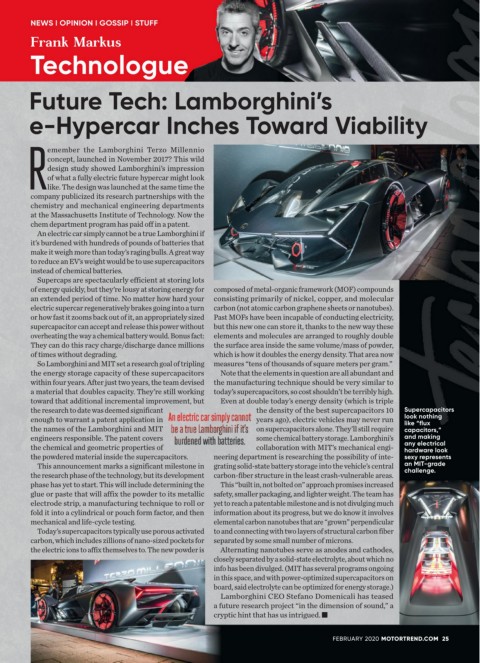
                emember  the  Lamborghini  Terzo  Millennio
                concept, launched in November 2017? This wild
                design study showed Lamborghini’s impression
                of what a fully electric future hypercar might look
          Rlike. The design was launched at the same time the
           company publicized its research partnerships with the
           chemistry and mechanical engineering departments
           at the Massachusetts Institute of Technology. Now the
           chem department program has paid off in a patent.
             An electric car simply cannot be a true Lamborghini if
           it’s burdened with hundreds of pounds of batteries that
           make it weigh more than today’s raging bulls. A great way
           to reduce an EV’s weight would be to use supercapacitors
           instead of chemical batteries.
             Supercaps are spectacularly efficient at storing lots
           of energy quickly, but they’re lousy at storing energy for   composed of metal-organic framework (MOF) compounds
           an extended period of time. No matter how hard your        consisting primarily of nickel, copper, and molecular
           electric supercar regeneratively brakes going into a turn   carbon (not atomic carbon graphene sheets or nanotubes).
           or how fast it zooms back out of it, an appropriately sized   Past MOFs have been incapable of conducting electricity,
           supercapacitor can accept and release this power without   but this new one can store it, thanks to the new way these
           overheating the way a chemical battery would. Bonus fact:   elements and molecules are arranged to roughly double
           They can do this racy charge/discharge dance millions      the surface area inside the same volume/mass of powder,
           of times without degrading.                                which is how it doubles the energy density. That area now
             So Lamborghini and MIT set a research goal of tripling   measures “tens of thousands of square meters per gram.”
           the energy storage capacity of these supercapacitors         Note that the elements in question are all abundant and
           within four years. After just two years, the team devised   the manufacturing technique should be very similar to
           a material that doubles capacity. They’re still working    today’s supercapacitors, so cost shouldn’t be terribly high.
           toward that additional incremental improvement, but          Even at double today’s energy density (which is triple
           the research to date was deemed significant                              the density of the best supercapacitors 10     Supercapacitors
                                                                                                                                   look nothing
           enough to warrant a patent application in                                years ago), electric vehicles may never run
                                                                                                                                   like “flux
           the names of the Lamborghini and MIT                                     on supercapacitors alone. They’ll still require   capacitors,”
           engineers responsible. The patent covers                                 some chemical battery storage. Lamborghini’s   and making
                                                                                                                                   any electrical
           the chemical and geometric properties of                                 collaboration with MIT’s mechanical engi-
                                                                                                                                   hardware look
           the powdered material inside the supercapacitors.          neering department is researching the possibility of inte-   sexy represents
             This announcement marks a significant milestone in       grating solid-state battery storage into the vehicle’s central   an MIT-grade
                                                                                                                                   challenge.
           the research phase of the technology, but its development   carbon-fiber structure in the least crash-vulnerable areas.
           phase has yet to start. This will include determining the    This “built in, not bolted on” approach promises increased
           glue or paste that will affix the powder to its metallic   safety, smaller packaging, and lighter weight. The team has
           electrode strip, a manufacturing technique to roll or      yet to reach a patentable milestone and is not divulging much
           fold it into a cylindrical or pouch form factor, and then   information about its progress, but we do know it involves
           mechanical and life-cycle testing.                         elemental carbon nanotubes that are “grown” perpendicular
             Today’s supercapacitors typically use porous activated   to and connecting with two layers of structural carbon fiber
           carbon, which includes zillions of nano-sized pockets for   separated by some small number of microns.
           the electric ions to affix themselves to. The new powder is   Alternating nanotubes serve as anodes and cathodes,
                                                                      closely separated by a solid-state electrolyte, about which no
                                                                      info has been divulged. (MIT has several programs ongoing
                                                                      in this space, and with power-optimized supercapacitors on
                                                                      board, said electrolyte can be optimized for energy storage.)
                                                                        Lamborghini CEO Stefano Domenicali has teased
                                                                      a future research project “in the dimension of sound,” a
                                                                      cryptic hint that has us intrigued. Q


                                                                                                             FEBRUARY 2020 MOTORTREND.COM  25

