


Page 44 - Motor Trend (February 2020)
P. 44
communicative, responsive, and easy to
                                                                                                       drive (despite said understeer).
                                                                                                         So how did that big midcorner push get
                                                                                                       past the Corvette engineers? We don’t
                                                                                                       think it did. We think it’s intentional,
                                                                                                       especially with the suspension in Street
                                                                                                       alignment. The vast majority of Corvettes
                                                                                                       sold are base models, and the vast majority
                                                                                                       of customers will never have driven a
                                                                                                       mid-engine car before, much less one this
                                                                                                       quick. Understeer is safe, in that it makes it
                                                                                                       very difficult for the car to oversteer—and
                                                                                                       when this car does oversteer, it’s a very fine
                                                                                                       line between a sweet little drift and going
                                                                                                       backward off the road. Drivers who prefer
                                                                                                       exploring varying degrees of the safety
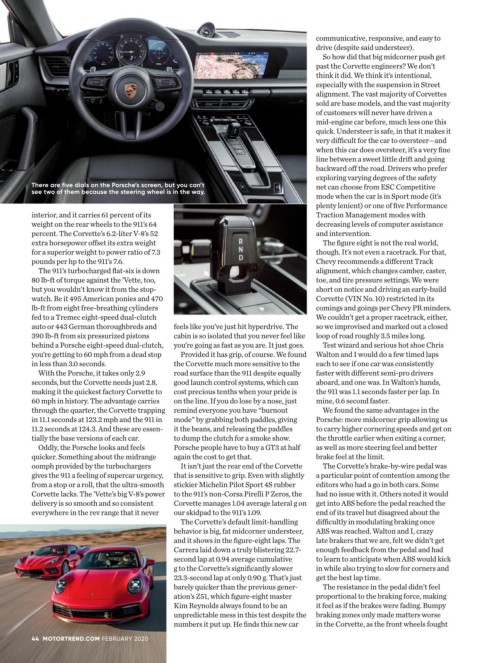
           There are five dials on the Porsche’s screen, but you can’t                                 net can choose from ESC Competitive
           see two of them because the steering wheel is in the way.
                                                                                                       mode when the car is in Sport mode (it’s
                                                                                                       plenty lenient) or one of five Performance
           interior, and it carries 61 percent of its                                                  Traction Management modes with
           weight on the rear wheels to the 911’s 64                                                   decreasing levels of computer assistance
           percent. The Corvette’s 6.2-liter V-8’s 52                                                  and intervention.
           extra horsepower offset its extra weight                                                      The figure eight is not the real world,
           for a superior weight to power ratio of 7.3                                                 though. It’s not even a racetrack. For that,
           pounds per hp to the 911’s 7.6.                                                             Chevy recommends a different Track
             The 911’s turbocharged flat-six is down                                                    alignment, which changes camber, caster,
           80 lb-ft of torque against the ’Vette, too,                                                 toe, and tire pressure settings. We were
           but you wouldn’t know it from the stop-                                                     short on notice and driving an early-build
           watch. Be it 495 American ponies and 470                                                    Corvette (VIN No. 10) restricted in its
           lb-ft from eight free-breathing cylinders                                                   comings and goings per Chevy PR minders.
           fed to a Tremec eight-speed dual-clutch                                                     We couldn’t get a proper racetrack, either,
           auto or 443 German thoroughbreds and          feels like you’ve just hit hyperdrive. The    so we improvised and marked out a closed
           390 lb-ft from six pressurized pistons        cabin is so isolated that you never feel like   loop of road roughly 3.5 miles long.
           behind a Porsche eight-speed dual-clutch,     you’re going as fast as you are. It just goes.   Test wizard and serious hot shoe Chris
           you’re getting to 60 mph from a dead stop       Provided it has grip, of course. We found   Walton and I would do a few timed laps
           in less than 3.0 seconds.                     the Corvette much more sensitive to the       each to see if one car was consistently
             With the Porsche, it takes only 2.9         road surface than the 911 despite equally     faster with different semi-pro drivers
           seconds, but the Corvette needs just 2.8,     good launch control systems, which can        aboard, and one was. In Walton’s hands,
           making it the quickest factory Corvette to    cost precious tenths when your pride is       the 911 was 1.1 seconds faster per lap. In
           60 mph in history. The advantage carries      on the line. If you do lose by a nose, just   mine, 0.6 second faster.
           through the quarter, the Corvette trapping  remind everyone you have “burnout                 We found the same advantages in the
           in 11.1 seconds at 123.2 mph and the 911 in   mode” by grabbing both paddles, giving        Porsche: more midcorner grip allowing us
           11.2 seconds at 124.3. And these are essen-   it the beans, and releasing the paddles       to carry higher cornering speeds and get on
           tially the base versions of each car.         to dump the clutch for a smoke show.          the throttle earlier when exiting a corner,
             Oddly, the Porsche looks and feels          Porsche people have to buy a GT3 at half      as well as more steering feel and better
           quicker. Something about the midrange         again the cost to get that.                   brake feel at the limit.
           oomph provided by the turbochargers             It isn’t just the rear end of the Corvette    The Corvette’s brake-by-wire pedal was
           gives the 911 a feeling of supercar urgency,   that is sensitive to grip. Even with slightly   a particular point of contention among the
           from a stop or a roll, that the ultra-smooth   stickier Michelin Pilot Sport 4S rubber      editors who had a go in both cars. Some
           Corvette lacks. The ’Vette’s big V-8’s power  to the 911’s non-Corsa Pirelli P Zeros, the   had no issue with it. Others noted it would
           delivery is so smooth and so consistent       Corvette manages 1.04 average lateral g on    get into ABS before the pedal reached the
           everywhere in the rev range that it never     our skidpad to the 911’s 1.09.                end of its travel but disagreed about the
                                                           The Corvette’s default limit-handling       difficultly in modulating braking once
                                                         behavior is big, fat midcorner understeer,    ABS was reached. Walton and I, crazy
                                                         and it shows in the figure-eight laps. The     late brakers that we are, felt we didn’t get
                                                         Carrera laid down a truly blistering 22.7-    enough feedback from the pedal and had
                                                         second lap at 0.94 average cumulative         to learn to anticipate when ABS would kick
                                                         g to the Corvette’s significantly slower       in while also trying to slow for corners and
                                                         23.3-second lap at only 0.90 g. That’s just   get the best lap time.
                                                         barely quicker than the previous gener-         The resistance in the pedal didn’t feel
                                                         ation’s Z51, which figure-eight master         proportional to the braking force, making
                                                         Kim Reynolds always found to be an            it feel as if the brakes were fading. Bumpy
                                                         unpredictable mess in this test despite the   braking zones only made matters worse
                                                         numbers it put up. He finds this new car       in the Corvette, as the front wheels fought

           44  MOTORTREND.COM FEBRUARY 2020

