


Page 44 - World of Animals - Book of Sharks & Ocean Predators
P. 44
Sharks & Ocean Predators
                               WorldMags.net

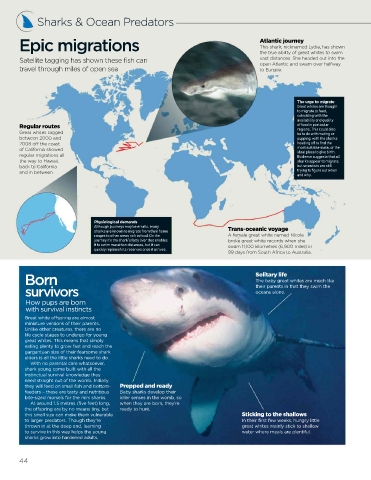
        Epic migrations                                                                     Atlantic journey
                                                                                            This shark, nicknamed Lydia, has shown
                                                                                            the true ability of great whites to swim
        Satellite tagging has shown these fi sh can                                          vast distances. She headed out into the
                                                                                            open Atlantic and swam over halfway
        travel through miles of open sea                                                    to Europe.


                                                                                                         The urge to migrate
                                                                                                         Great whites are thought
                                                                                                         to migrate to feed,
                                                                                                         coinciding with the
                                                                                                         availability and quality
        Regular routes                                                                                   of food in particular
                                                                                                         regions. This could also
        Great whites tagged                                                                              be to do with mating or
        between 2000 and                                                                                 pupping, with the sharks


        2008 off the coast                                                                               heading off to find the
                                                                                                         most suitable mate, or the
        of California showed
                                                                                                         ideal place to give birth.
        regular migrations all                                                                           Evidence suggests that all
        the way to Hawaii,                                                                               sharks appear to migrate,
        back to California                                                                               but scientists are still
                                                                                                         trying to figure out when

        and in between.
                                                                                                         and why.


                                  Physiological demands
                                  Although journeys may be erratic, many
                                  sharks are known to migrate from their home    Trans-oceanic voyage
                                  ranges to other areas rich in food. On the     A female great white named Nicole
                                  journey it’s the shark’s fatty liver that enables   broke great white records when she
                                  it to swim marathon distances, but it can      swam 11,100 kilometres (6,900 miles) in
                                  quickly replenish its reserves once it arrives.
                                                                                 99 days from South Africa to Australia.


          Born                                                                             Solitary life
                                                                                           The baby great whites are much like
          survivors                                                                        their parents in that they swim the
                                                                                           oceans alone.
          How pups are born
          with survival instincts
          Great white offspring are almost
          miniature versions of their parents.
          Unlike other creatures, there are no
          life cycle stages to undergo for young
          great whites. This means that simply
          eating plenty to grow fast and reach the
          gargantuan size of their fearsome shark
          elders is all the little sharks need to do.
            With no parental care whatsoever,
          shark young come built with all the
          instinctual survival knowledge they
          need straight out of the womb. Initially
          they will feed on small fish and bottom-  Prepped and ready

          feeders – these are tasty and nutritious   Baby sharks develop their
          bite-sized morsels for the mini sharks.   killer senses in the womb, so
            At around 1.5 metres (five feet) long,   when they are born, they’re

          the offspring are by no means tiny, but   ready to hunt.
          this small size can make them vulnerable                                    Sticking to the shallows
          to larger predators. Though they’re                                         In their first few weeks, hungry little

          thrown in at the deep end, learning                                         great whites mainly stick to shallow
          to survive in this way helps the young                                      water where meals are plentiful.
          sharks grow into hardened adults.


        44
                                                      WorldMags.net
                                                      WorldMags.net

