


Page 51 - World of Animals - Book of Sharks & Ocean Predators
P. 51
Great white sharks
                               WorldMags.net

                                 The great white in numbers

                                                                                                                       -
                                                                         -
                                             05-07                  20 30         tons 06              300         2530
                                 25 mph       teeth ready to  48 % YEARS        03
                                              The rows of
                                   The speed a                                                          The number of  CM
                                  shark can reach   move into a   Shark surface   The average
                                 prior to an attack   frontal position   attacks that   lifespan of a   How much a  metres  teeth a shark can   The amount
                                  to pursue and   when one is lost   actually result in   great white in   great white can   How long they   have in its mouth   a great white
                                  catch its prey.  or broken.  successful kills.   the wild.  weigh up to.  can grow.  at any one time.  grows per year.
                                “A great white can smell a seal colony from 2 miles away”

                                 of Natural History points out, bees, wasps and snakes are   kills purely to eat and survive. As part of the research
                                 responsible for far more fatalities every year and, in the   conducted by Neil Hammerschlag of the University
                                 United States, up to 30-times more deaths occur as a   of Miami, Florida, geographic profiling (a police tool

                                 result of lightning strikes per year than from shark attacks.  for analysing serial crime) was used to observe shark
                                   In reality, great whites have more in common with   behaviour at Seal Island in False Bay, South Africa. Named
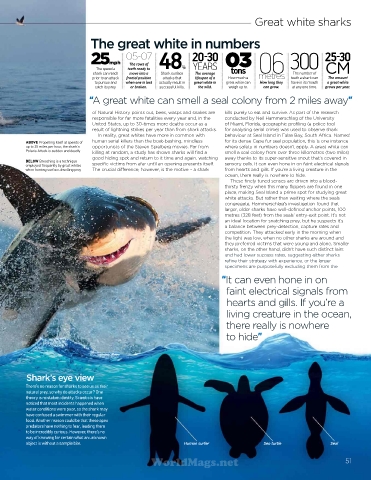
          ABOVE Propelling itself at speeds of   human serial killers than the boat-bashing, mindless   for its dense Cape fur seal population, this is one instance
          up to 25 miles per hour, the shark’s   opportunists of the Steven Spielberg movies. Far from   where safety in numbers doesn’t apply. A great white can
          Polaris Attack is sudden and deadly  killing at random, a study has shown sharks will fi nd a   smell a seal colony from over three killometres (two miles)
                                 good hiding spot and return to it time and again, watching   away thanks to its super-sensitive snout that’s covered in
          BELOW Breaching is a technique

          employed frequently by great whites   specific victims from afar until an opening presents itself.   sensory cells. It can even hone in on faint electrical signals
          when hunting surface-dwelling prey  The crucial difference, however, is the motive – a shark   from hearts and gills. If you’re a living creature in the
                                                                                ocean, there really is nowhere to hide.
                                                                                  These finely tuned senses are driven into a blood-


                                                                                thirsty frenzy when this many flippers are found in one
                                                                                place, making Seal Island a prime spot for studying great
                                                                                white attacks. But rather than waiting where the seals
                                                                                congregate, Hammerschlag’s investigation found that
                                                                                larger, older sharks have well-defined anchor points, 100

                                                                                metres (328 feet) from the seals’ entry-exit point. It’s not
                                                                                an ideal location for snatching prey, but he suspects it’s
                                                                                a balance between prey-detection, capture rates and
                                                                                competition. They attacked early in the morning when
                                                                                the light was low, when no other sharks are around and
                                                                                they preferred victims that were young and alone. Smaller
                                                                                sharks, on the other hand, didn’t have such distinct lairs
                                                                                and had lower success rates, suggesting either sharks

                                                                                refine their strategy with experience, or the larger
                                                                                specimens are purposefully excluding them from the
                                                                               “ It can even hone in on

                                                                                faint electrical signals from

                                                                                 hearts and gills. If you’re a
                                                                                 living creature in the ocean,
                                                                                there really is nowhere

                                                                                to hide”


          Shark’s eye view
          There’s no reason for sharks to see us as their
          natural prey, so why do attacks occur? One
          theory is mistaken identity. Scientists have
          noticed that most incidents happened when
          water conditions were poor, so the shark may
          have confused a swimmer with their regular
          food. Another reason could be that these apex
          predators have nothing to fear, leading them
          to be incredibly curious. However, there’s no
          way of knowing for certain what an unknown
          object is without a sample bite.                        Human surfer                Sea turtle             Seal

                                                                                                                          51
                                                      WorldMags.net
                                                      WorldMags.net

