


Page 24 - Complete Cat Care: How To Keep Your Cat Healthy and Happy
P. 24
Understanding your cat


            Cats did not evolve to be social animals. Highly independent, they have
            developed subtle and complex ways of behaving and communicating that
            often send confusing messages to their owners.

            Cat behavior                    sophisticated body language. Their   at these times might cause an
            Domestic cats evolved from a small,   solitary past also means that cats   indoor cat to have a “mad half-
            solitary, and territorial predator   are more independent than most   hour,” dashing about energetically.
            that rarely met others of its kind.   other pet species and although   Because their eyesight evolved
            This feline ancestor did not need    many enjoy cuddles, they still   primarily to detect movement in
            to develop a complex visual     appreciate their own space.    poor light, cats do not see patterns
            communication system like that of   Cats are supreme hunters and   or colors with the same clarity as
            more naturally social species, such   because their prey is more active at   humans do. Their eyes are not
            as dogs and humans, so our pet cats   dawn and dusk, this is when cats   sensitive to colors at the red end
            today do not have a particularly   are most active. Motivation to hunt   of the spectrum and, as a result,
     22                                                                    they may have difficulty picking
                                                                           out red toys against a pink carpet.
                                                                           On the other hand, they are
                                                                           extremely quick to respond to a
      Your new cat                                                         trailing string.
                                                                             The sense of smell is very
                                                                           important to cats. They head-rub to
                                                                           deposit scent in areas where they


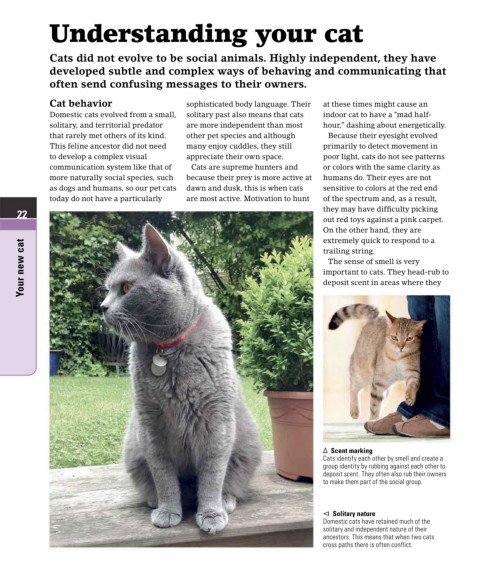
                                                                           △  Scent marking
                                                                           Cats identify each other by smell and create a
                                                                           group identity by rubbing against each other to
                                                                           deposit scent. They often also rub their owners
                                                                           to make them part of the social group.


                                                                           ◁  Solitary nature
                                                                           Domestic cats have retained much of the
                                                                           solitary and independent nature of their
                                                                           ancestors. This means that when two cats
                                                                           cross paths there is often conflict.


   US_022-023_Understanding_your_cat.indd   22                                                       24/10/2013   14:58

