


Page 39 - Complete Cat Care: How To Keep Your Cat Healthy and Happy
P. 39
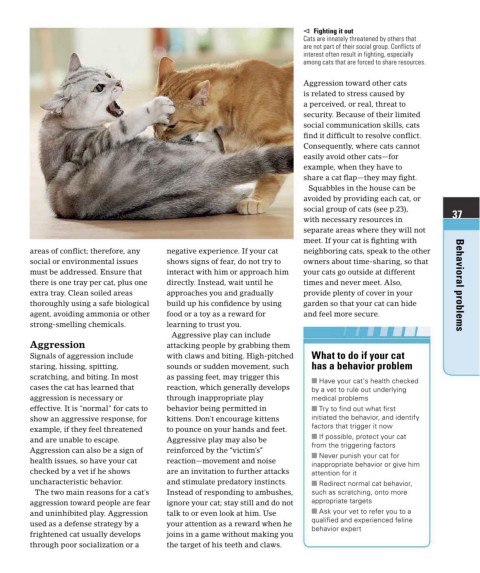
◁  Fighting it out
                                                                       Cats are innately threatened by others that
                                                                       are not part of their social group. Conflicts of
                                                                       interest often result in fighting, especially
                                                                       among cats that are forced to share resources.

                                                                       Aggression toward other cats
                                                                       is related to stress caused by
                                                                       a perceived, or real, threat to
                                                                       security. Because of their limited
                                                                       social communication skills, cats
                                                                       find it difficult to resolve conflict.
                                                                       Consequently, where cats cannot
                                                                       easily avoid other cats—for
                                                                       example, when they have to
                                                                       share a cat flap—they may fight.
                                                                        Squabbles in the house can be
                                                                       avoided by providing each cat, or
                                                                       social group of cats (see p.23),    37
                                                                       with necessary resources in
                                                                       separate areas where they will not
                                                                       meet. If your cat is fighting with
        areas of conflict; therefore, any   negative experience. If your cat   neighboring cats, speak to the other
        social or environmental issues   shows signs of fear, do not try to   owners about time-sharing, so that
        must be addressed. Ensure that   interact with him or approach him   your cats go outside at different
        there is one tray per cat, plus one   directly. Instead, wait until he   times and never meet. Also,   Behavioral problems
        extra tray. Clean soiled areas   approaches you and gradually   provide plenty of cover in your
        thoroughly using a safe biological   build up his confidence by using   garden so that your cat can hide
        agent, avoiding ammonia or other   food or a toy as a reward for   and feel more secure.
        strong-smelling chemicals.     learning to trust you.
                                        Aggressive play can include
        Aggression                     attacking people by grabbing them
        Signals of aggression include   with claws and biting. High-pitched   What to do if your cat
        staring, hissing, spitting,    sounds or sudden movement, such   has a behavior problem
        scratching, and biting. In most   as passing feet, may trigger this   ■ Have your cat's health checked
        cases the cat has learned that   reaction, which generally develops   by a vet to rule out underlying
        aggression is necessary or     through inappropriate play        medical problems
        effective. It is "normal" for cats to   behavior being permitted in   ■ Try to find out what first
        show an aggressive response, for   kittens. Don't encourage kittens    initiated the behavior, and identify
        example, if they feel threatened   to pounce on your hands and feet.   factors that trigger it now
        and are unable to escape.      Aggressive play may also be       ■ If possible, protect your cat
                                                                         from the triggering factors
        Aggression can also be a sign of   reinforced by the “victim’s”
        health issues, so have your cat   reaction—movement and noise    ■ Never punish your cat for
                                                                         inappropriate behavior or give him
        checked by a vet if he shows   are an invitation to further attacks   attention for it
        uncharacteristic behavior.     and stimulate predatory instincts.   ■ Redirect normal cat behavior,
         The two main reasons for a cat's   Instead of responding to ambushes,   such as scratching, onto more
        aggression toward people are fear   ignore your cat; stay still and do not   appropriate targets
        and uninhibited play. Aggression   talk to or even look at him. Use   ■ Ask your vet to refer you to a
        used as a defense strategy by a   your attention as a reward when he   qualified and experienced feline
                                                                         behavior expert
        frightened cat usually develops   joins in a game without making you
        through poor socialization or a   the target of his teeth and claws.


   US_036-037_Behaviour_problems.indd   37                                                           24/10/2013   14:57

