


Page 251 - (DK Eyewitness) Travel Guide - Rome
P. 251
V A TIC AN 249
times. Intended as a link
between the Vatican and Castel
Sant’Angelo, it constituted a
fortified escape route that
could also be used to control
the strategic Borgo area. Arrows
and other missiles could be fired
from its bastions onto the streets
and houses below. The corridor
was used in 1494 by Pope
Alexander VI Borgia when Rome
was invaded by King Charles VIII
of France. In 1527 it enabled
Pope Clement VII to take refuge
in Castel Sant’Angelo, as the
troops commanded by the
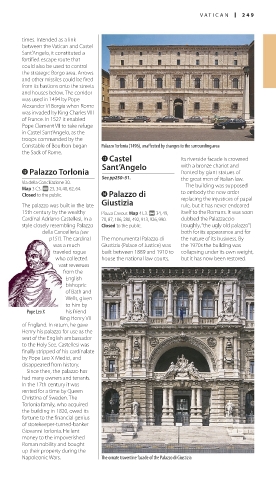
Constable of Bourbon began Palazzo Torlonia (1496), unaffected by changes to the surrounding area
the Sack of Rome.
e Castel Its riverside facade is crowned
Sant’Angelo with a bronze chariot and
w Palazzo Torlonia fronted by giant statues of
See pp250–51. the great men of Italian law.
Via della Conciliazione 30. The building was supposed
Map 3 C3. @ 23, 34, 40, 62, 64.
Closed to the public. r Palazzo di to embody the new order
Giustizia replacing the injustices of papal
The palazzo was built in the late rule, but it has never endeared
15th century by the wealthy Piazza Cavour. Map 4 E3. @ 34, 49, itself to the Romans. It was soon
Cardinal Adriano Castellesi, in a 70, 87, 186, 280, 492, 913, 926, 990. dubbed the Palazzaccio
style closely resembling Palazzo Closed to the public. (roughly, “the ugly old palazzo”)
della Cancelleria (see both for its appearance and for
p151). The cardinal The monumental Palazzo di the nature of its business. By
was a much- Giustizia (Palace of Justice) was the 1970s the building was
traveled rogue built between 1889 and 1910 to collapsing under its own weight,
who collected house the national law courts. but it has now been restored.
vast revenues
from the
English
bishopric
of Bath and
Wells, given
to him by
Pope Leo X his friend
King Henry VII
of England. In return, he gave
Henry his palazzo for use as the
seat of the English ambassador
to the Holy See. Castellesi was
finally stripped of his cardinalate
by Pope Leo X Medici, and
disappeared from history.
Since then, the palazzo has
had many owners and tenants.
In the 17th century it was
rented for a time by Queen
Christina of Sweden. The
Torlonia family, who acquired
the building in 1820, owed its
fortune to the financial genius
of storekeeper-turned-banker
Giovanni Torlonia. He lent
money to the impoverished
Roman nobility and bought
up their property during the
Napoleonic Wars. The ornate travertine facade of the Palazzo di Giustizia
US_248-249_EW_Rome_US.indd 249 15/03/17 4:21 pm

