


Page 26 - (DK Eyewitness) Travel Guide - Rome
P. 26
24 INTRODUCING ROME
The Roman Republic
By the mid-2nd century BC, Rome controlled the western
Mediterranean, policing and defending it with massive armies.
The troops had more loyalty to the generals than to distant
politicians, giving men like Marius, Sulla, Pompey, and Caesar
the muscle to seize political power. Meanwhile, peasants, whose
land had been destroyed during the invasion of Hannibal in
219 BC, had flooded into Rome. They were followed by slaves
and freedmen from conquered lands such as Greece, swelling Extent of the City
the population to half a million. There was plenty of work for 400 BC Today
immigrants, constructing roads, aqueducts, markets, and
temples, financed by taxes on Rome’s expanding trade.
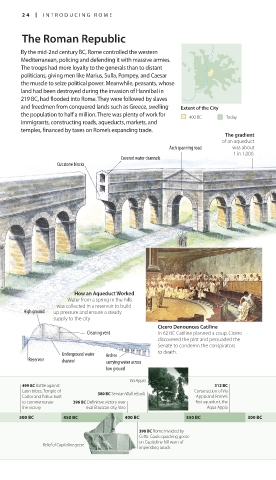
The gradient
of an aqueduct
Arch spanning road was about
1 in 1,000.
Covered water channels
Cut stone blocks
How an Aqueduct Worked
Water from a spring in the hills
was collected in a reservoir to build
High ground up pressure and ensure a steady
supply to the city.
Cicero Denounces Catiline
Cleaning vent In 62 BC Catiline planned a coup. Cicero
discovered the plot and persuaded the
Senate to condemn the conspirators
Underground water Arches to death.
Reservoir channel carrying water across
low ground
Via Appia
499 BC Battle against 312 BC
Latin tribes; Temple of 380 BC Servian Wall rebuilt Construction of Via
Castor and Pollux built Appia and Rome’s
to commemorate 396 BC Definitive victory over first aqueduct, the
the victory rival Etruscan city, Veio Aqua Appia
500 BC 450 BC 400 BC 350 BC 300 BC
390 BC Rome invaded by
Celtic Gauls: quacking geese 264–241 BC
on Capitoline hill warn of First Punic
Relief of Capitoline geese
impending attack War (against
Carthage)
US_024-025_EW_Rome_US.indd 24 15/03/17 4:19 pm

