


Page 72 - (DK Eyewitness) Travel Guide - Rome
P. 72
70 ROME AREA B Y AREA
1 Capitoline Museums: Palazzo Nuovo
A collection of Classical statues has been kept on
the Capitoline hill since the Renaissance. The first
group of bronze sculptures was given to the city
by Pope Sixtus IV in 1471, and additions were
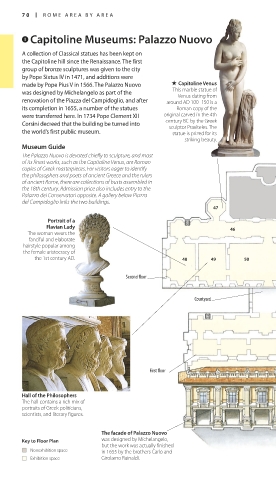
made by Pope Pius V in 1566. The Palazzo Nuovo . Capitoline Venus
was designed by Michelangelo as part of the This marble statue of
Venus dating from
renovation of the Piazza del Campidoglio, and after around AD 100–150 is a
its completion in 1655, a number of the statues Roman copy of the
were transferred here. In 1734 Pope Clement XII original carved in the 4th
Corsini decreed that the building be turned into century BC by the Greek
sculptor Praxiteles. The
the world’s first public museum. statue is prized for its
striking beauty.
Museum Guide
The Palazzo Nuovo is devoted chiefly to sculpture, and most
of its finest works, such as the Capitoline Venus, are Roman
copies of Greek masterpieces. For visitors eager to identify
the philosophers and poets of ancient Greece and the rulers
of ancient Rome, there are collections of busts assembled in
the 18th century. Admission price also includes entry to the
Palazzo dei Conservatori opposite. A gallery below Piazza
del Campidoglio links the two buildings.
47
Portrait of a e
Flavian Lady 46
The woman wears the
fanciful and elaborate
hairstyle popular among
the female aristocracy of
the 1st century AD. 48 49 50
Second floor
Courtyard
e
First floor
Hall of the Philosophers
The hall contains a rich mix of
portraits of Greek politicians,
scientists, and literary figures.
The facade of Palazzo Nuovo
Key to Floor Plan was designed by Michelangelo,
but the work was actually finished
Nonexhibition space in 1655 by the brothers Carlo and
Exhibition space Girolamo Rainaldi.
US_070-071_EW_Rome_US.indd 70 15/03/17 4:19 pm
Eyewitness Travel LAYERS PRINTED:
Starsight template “UK” LAYER
(Source v2)
Date 3rd September 2012
Size 125mm x 217mm

