


Page 92 - (DK Eyewitness) Travel Guide - Rome
P. 92
90 ROME AREA B Y AREA
i Trajan’s Markets
Originally considered among the wonders of the
Classical world, Trajan’s Markets now show only
a hint of their former splendor. Emperor Trajan
and his architect, Apollodorus of Damascus,
built this visionary new complex of 150 stores
and offices (probably used for administering the
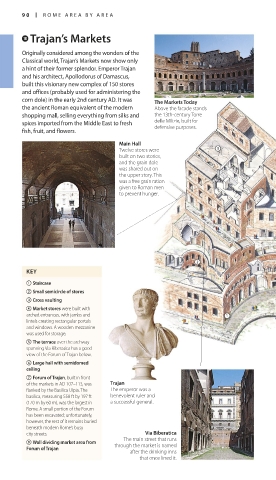
corn dole) in the early 2nd century AD. It was The Markets Today
the ancient Roman equivalent of the modern Above the facade stands
shopping mall, selling everything from silks and the 13th-century Torre
spices imported from the Middle East to fresh delle Milizie, built for
defensive purposes.
fish, fruit, and flowers.
Main Hall
Twelve stores were
built on two stories,
and the grain dole
was shared out on
the upper story. This
was a free grain ration
given to Roman men
to prevent hunger.
KEY
1 Staircase
2 Small semicircle of stores
3 Cross vaulting
4 Market stores were built with
arched entrances, with jambs and
lintels creating rectangular portals
and windows. A wooden mezzanine
was used for storage.
5 The terrace over the archway
spanning Via Biberatica has a good
view of the Forum of Trajan below.
6 Large hall with semidomed
ceiling
7 Forum of Trajan, built in front
of the markets in AD 107–113, was Trajan
flanked by the Basilica Ulpia. The The emperor was a
basilica, measuring 558 ft by 197 ft benevolent ruler and
(170 m by 60 m), was the largest in a successful general.
Rome. A small portion of the Forum
has been excavated; unfortunately,
however, the rest of it remains buried
beneath modern Rome’s busy
city streets. Via Biberatica
The main street that runs
8 Wall dividing market area from through the market is named
Forum of Trajan
after the drinking inns
that once lined it.
US_090-091_EW_Rome_US.indd 90 15/03/17 4:19 pm
Eyewitness Travel LAYERS PRINTED:
Starsight template “UK” LAYER
(Source v2)
Date 3rd September 2012
Size 125mm x 217mm

