


Page 58 - Forbes - USA (March 2018)
P. 58
TH E  WORLDÕ S  BILLIO NA IR E S

                    a
        MuKeSH MBanI                                        a refundable security deposit of $22. In all Reliance has spent
                                                            $33 billion on the project to date, funding it with a mix of debt
        him) would have total management control. Anil, who was vice   ($7 billion), equity ($17 billion), plus deferred payments and
        chairman, didn’t see it that way and wanted to have more of a   supplier credits ($9 billion).
        say. Mukesh felt he had done all the behind-the-scenes work   Jio was impossibly cheap and impossibly fast and, perhaps

        of building the big plants and refineries. He was also said to be   most impressive given India’s size, nearly ubiquitous, available

        closer to his father, who was initially furious when Anil decid-  in 95% of the country. The incumbent players struggled merely
        ed to marry a Bollywood starlet, which he didn’t feel was an ap-  to stay in business. Telenor and the Tata Group both sold their
        propriate choice. (Mukesh’s wife had been chosen by his father.)   wireless operations to telecom tycoon Sunil Mittal’s Bharti Air-
        Anil, who is more articulate and extroverted than his brother,   tel, a joint venture with Singapore’s Singtel. Onetime rivals Vo-

        was in charge of finance and was the face of Reliance to bankers,   dafone India and Idea Cellular, owned by billionaire Kumar
        investors and journalists. He was closer to his mother.   Birla, agreed to merge to better withstand the onslaught. And
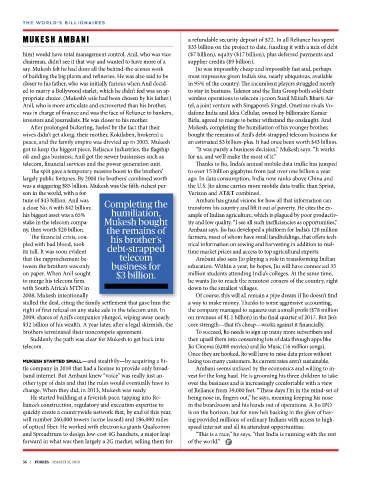
           After prolonged bickering, fueled by the fact that their   Mukesh, completing the humiliation of his younger brother,

        wives didn’t get along, their mother, Kokilaben, brokered a   bought the remains of Anil’s debt-strapped telecom business for
        peace, and the family empire was divvied up in 2005. Mukesh   an estimated $3 billion-plus. It had once been worth $43 billion.

        got to keep the biggest piece, Reliance Industries, the flagship   “It was purely a business decision,” Mukesh says. “It works
        oil-and-gas business; Anil got the newer businesses such as   for us, and we’ll make the most of it.”


        telecom, financial services and the power-generation unit.  Thanks to Jio, India’s annual mobile data traffic has jumped

           The split gave a temporary massive boost to the brothers’   to over 15 billion gigabytes from just over one billion a year

        largely public fortunes. By 2008 the brothers’ combined worth   ago. In data consumption, India now ranks above China and


        was a staggering $85 billion. Mukesh was the fifth-richest per-  the U.S. Jio alone carries more mobile data traffic than Sprint,


        son in the world, with a for-                       Verizon and AT&T combined.
        tune of $43 billion. Anil was   Completing the         Ambani has grand visions for how all that information can
        a close No. 6 with $42 billion;                     transform his country and lift it out of poverty. He cites the ex-

        his biggest asset was a 65%   humiliation,          ample of Indian agriculture, which is plagued by poor productiv-
        stake in the telecom compa-  Mukesh bought          ity and low quality. “I see all such inefficiencies as opportunities,”


        ny, then worth $20 billion.  the remains of         Ambani says. Jio has developed a platform for India’s 120 million
           The financial crisis, cou-  his brother’s        farmers, most of whom have small landholdings, that offers tech-


        pled with bad blood, took                           nical information on sowing and harvesting in addition to real-
        its toll. It was soon evident   debt-strapped       time market prices and access to top agricultural experts.
        that the rapprochement be-     telecom                 Ambani also sees Jio playing a role in transforming Indian
        tween the brothers was only   business for          education. Within a year, he hopes, Jio will have connected 35
        on paper. When Anil sought    $3 billion.           million students attending India’s colleges. At the same time,

        to merge his telecom firm                           he wants Jio to reach the remotest corners of the country, right
        with South Africa’s MTN in                          down to the smallest villages.
        2008, Mukesh intentionally                             Of course, this will all remain a pipe dream if Jio doesn’t find


        stalled the deal, citing the family settlement that gave him the   a way to make money. Thanks to some aggressive accounting,

        right of first refusal on any stake sale in the telecom unit. In   the company managed to squeeze out a small profit ($78 million

        2009, shares of Anil’s companies plunged, wiping away nearly   on revenues of $1.1 billion) in the final quarter of 2017. But Jio’s


        $32 billion of his wealth. A year later, after a legal skirmish, the   core strength—that it’s cheap—works against it financially.

        brothers terminated their noncompete agreement.        To succeed, Jio needs to sign up many more subscribers and
           Suddenly the path was clear for Mukesh to get back into   then upsell them into consuming lots of data through apps like
        telecom.                                            Jio Cinema (6,000 movies) and Jio Music (16 million songs).
                                                            Once they are hooked, Jio will have to raise data prices without
        MUKESH STARTED SMALL—and stealthily—by acquiring a lit-  losing too many customers. Its current rates aren’t sustainable.
        tle company in 2010 that had a license to provide only broad-  Ambani seems unfazed by the economics and willing to in-
        band internet. But Ambani knew “voice” was really just an-  vest for the long haul. He is grooming his three children to take
        other type of data and that the rules would eventually have to   over the business and is increasingly comfortable with a view
        change. When they did, in 2013, Mukesh was ready.   of Reliance from 39,000 feet. “These days I’m in the mind-set of


           He started building at a feverish pace, tapping into Re-  being nose in, fingers out,” he says, meaning keeping his nose
        liance’s construction, regulatory and execution expertise to   in the boardroom and his hands out of operations. A Jio IPO
        quickly create a countrywide network that, by end of this year,   is on the horizon, but for now he’s basking in the glow of hav-
        will number 260,000 towers (some leased) and 186,000 miles   ing provided millions of ordinary Indians with access to high-
        of optical fiber. He worked with electronics giants Qualcomm   speed internet and all its attendant opportunities.


        and Spreadtrum to design low-cost 4G handsets, a major leap   “This is a race,” he says, “that India is running with the rest
        forward in what was then largely a 2G market, selling them for   of the world.”  F
        56     |     FORBES     MARCH 31, 2018

