


Page 150 - (DK Eyewitness) Top 10 Travel Guide - Brussels Bruges Ghent & Antwerp
P. 150
148 TR A VELLERS ’ NEEDS
Belgian Beer
Belgium makes more beers, in a greater mix of styles and
flavours, than any other country in the world. The Belgian
citizen drinks on average 100 litres (200 pints) a year, and
even small bars will stock at least 20 varieties. The nation’s
breweries produce over 400 different beers.
The cheerful peasants in Brueghel the Elder’s 16th-century
medieval village scenes would have been drinking beer from
their local brewery, many of which had been active since the
11th century, as every small town and com munity produced
its own beer. By 1900, there remained 3,000 private breweries
throughout Belgium. Today, more than 100 still operate, with
experts agreeing that even large industrial concerns produce
a fine quality beer.
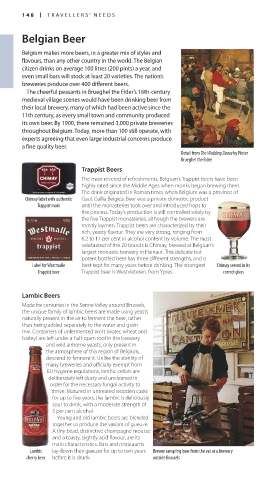
Detail from The Wedding Dance by Pieter
Brueghel the Elder
Trappist Beers
The most revered of refreshments, Belgium’s Trappist beers have been
highly rated since the Middle Ages when monks began brewing them.
The drink originated in Roman times when Belgium was a province of
Chimay label with authentic Gaul, Gallia Belgica. Beer was a private domestic product
Trappist mark until the monasteries took over and introduced hops to
the process. Today’s production is still controlled solely by
the five Trappist monasteries, although the brewers are
mostly laymen. Trappist beers are characterized by their
rich, yeasty flavour. They are very strong, ranging from
6.2 to 11 per cent in alcohol content by volume. The most
celebrated of the 20 brands is Chimay, brewed at Belgium’s
largest monastic brewery in Hainaut. This delicate but
potent bottled beer has three different strengths, and is
Label for Westmalle best kept for many years before drinking. The strongest Chimay served in its
Trappist beer Trappist beer is Westvleteren, from Ypres. correct glass
Lambic Beers
Made for centuries in the Senne Valley around Brussels,
the unique family of lambic beers are made using yeasts
naturally present in the air to ferment the beer, rather
than being added separately to the water and grain
mix. Containers of unferm ented wort (water, wheat and
barley) are left under a half-open roof in the brewery
and wild airborne yeasts, only present in
the atmos phere of this region of Belgium,
descend to ferment it. Unlike the sterility of
many breweries and officially exempt from
EU hygiene regulations, lambic cellars are
deliberately left dusty and uncleaned in
order for the necessary fungal activity to
thrive. Matured in untreated wooden casks
for up to five years, the lambic is deliciously
sour to drink, with a moder ate strength of
5 per cent alcohol.
Young and old lambic beers are blend ed
together to produce the variant of gueuze.
A tiny bead, distinctive champ agne mousse
and a toasty, slightly acid flavour, are its
main characteristics. Bars and restaurants
Lambic lay down their gueuze for up to two years Brewer sampling beer from the vat at a brewery
cherry beer before it is drunk. outside Brussels
148-149_EW_Brussels.indd 148 10/01/17 10:55 am
Eyewitness Travel LAYERS PRINTED:
What to Drink template “UK” LAYER
(Source v1.2)
Date 7th January 2013
Size 125mm x 217mm

