


Page 90 - All About History - Issue 56-17
P. 90
REVIEWS


                         All About History on the books, TV shows and

                                films causing a stir in the history world

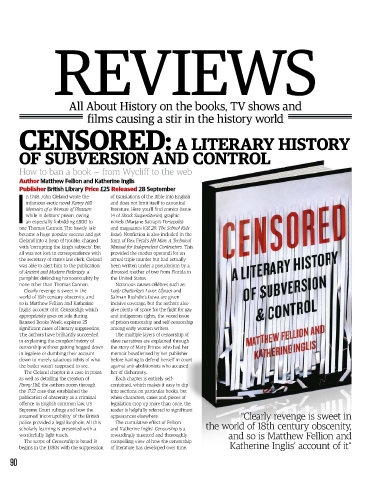
        CENSORED:                                              A    LITERARY                       HISTORY


        OF       SUBVERSION                            AND           CONTROL


        How to ban a book — from Wycliff to the web
        Author Matthew  Fellion  and  Katherine  Inglis
        Publisher British  Library  Price £25 Released 28 September
          n 1748, John Cleland wrote the   of translations of the Bible into English
          infamous erotic novel Fanny Hill:   and does not limit itself to canonical
          Memoirs of a Woman of Pleasure   literature. Here you’ll find comics (issue
          while in debtors’ prison, owing   14 of Shock SuspenStories), graphic
       I an especially forbidding £800 to   novels (Marjane Satrapi’s Persepolis)
        one Thomas Cannon. The bawdy tale   and magazines (OZ 28: The School Kids
        became a huge popular success and got   Issue). Nonfiction is also included in the
        Cleland into a heap of trouble, charged   form of Rex Feral’s Hit Man: A Technical
        with ‘corrupting the king’s subjects’. But   Manual for Independent Contractors. This
        all was not lost: in correspondence with   provided the modus operandi for an
        the secretary of state’s law clerk, Cleland   actual triple murder but had actually
        was able to alert him to the publication   been written under a pseudonym by a
        of Ancient and Modern Pederasty, a   divorced mother of two from Florida in
        pamphlet defending homosexuality by   the United States.
        none other than Thomas Cannon.    Notorious causes célèbres such as
          Clearly revenge is sweet in the   Lady Chatterley’s Lover, Ulysses and
        world of 18th century obscenity, and   Salman Rushdie’s fatwa are given
        so is Matthew Fellion and Katherine   incisive coverage, but the authors also
        Inglis’ account of it. Censorship, which   give plenty of space for the fight for gay
        appropriately goes on sale during   and indigenous rights, the vexed issue
        Banned Books Week, explores 25   of prison censorship and self-censorship
        significant cases of literary suppression.   among early women writers.
        The authors have brilliantly succeeded   The multiple layers of censorship of
        in explaining the complex history of   slave narratives are explained through
        censorship without getting bogged down   the story of Mary Prince, who had her
        in legalese or dumbing their account   memoir bowdlerised by her publisher
        down to merely salacious titbits of what   before having to defend herself in court
        the butler wasn’t supposed to see.   against anti-abolitionists who accused
          The Cleland chapter is a case in point:   her of dishonesty.
        as well as detailing the creation of    Each chapter is entirely self-
        Fanny Hill, the authors zoom through   contained, which makes it easy to dip
        the 1727 case that established the   into sections on particular books, but
        publication of obscenity as a criminal   when characters, cases and pieces of
        offence in English common law, US   legislation crop up more than once, the
        Supreme Court rulings and how the   reader is helpfully referred to significant
        assumed ‘incorruptibility’ of the British   appearances elsewhere.            “Clearly revenge is sweet in
        police provided a legal loophole. All this   The cumulative effect of Fellion   the world of 18th century obscenity,
        scholarly learning is presented with a   and Katherine Inglis’ Censorship is a
        wonderfully light touch.        rewardingly nuanced and thoroughly       and so is Matthew Fellion and
          The scope of Censorship is broad. It   compelling view of how the censorship
        begins in the 1380s with the suppression   of literature has developed over time.   Katherine Inglis’ account of it”
     90

