


Page 120 - (DK Eyewitness) Travel Guide - London
P. 120
118 L ONDON AREA B Y AREA
1 The Piazza and
Central Market
Covent Garden WC2. Map 13 C2.
1 Covent Garden. 7 but cobbled
streets. Street performers 10am–dusk
daily. See Shops and Markets p319.
∑ coventgarden.london
The 17th-century architect
Inigo Jones originally planned
this area to be an elegant
residential square, modelled
on the piazza of Livorno in
northern Italy. Today the West entrance to St Paul’s
buildings on and around
the Piazza are almost entirely 2 St Paul’s Church “The Actors’ Church” and plaques
Victorian. The covered central Bedford St WC2. Map 13 C2. Tel 020 commemorate distinguished
market was designed by 7836 5222. 1 Covent Garden. Open men and women of the theatre.
Charles Fowler in 1833 for fruit 8:30am–5pm Mon–Fri, some Sats A 17th-century carving by Grin-
and vegetable whole salers, depending on events, 9am–1pm Sun. l ing Gibbons on the west screen
the glass and iron roof 5 1:20pm Tue & Wed, 11am Sun, is a memorial to the architect.
anticipating the giant rail termini 2nd Sun of the month 4pm evensong.
built later in the century – for 7 ∑ actorschurch.org 3 London
instance, St Pancras (see p134)
and Waterloo (see p195). It now Inigo Jones built this church Transport Museum
makes a magnificent shell for (completed in 1633) with the The Piazza WC2. Map 13 C2. Tel 020
an array of small shops selling altar at the west end, so as to 7379 6344. 1 Covent Garden.
designer clothes, books, arts, allow his grand portico, with its Open 10am–6pm Sat–Thu,
crafts, decorative items and two square and two round 11am–6pm Fri (last adm: 5:15pm).
antiques, surrounded by col umns, to face east into & - = 7 8 book ahead.
bustling market stalls the Piazza. Clerics objected ∑ ltmuseum.co.uk
that continue south in to this unortho dox
the neighbouring arrange ment, and the You do not have to be a train
Jubilee Hall, which altar was moved to its con- spotter or a collector of bus
was built in 1903. ventional position at the numbers to enjoy this museum.
The colonnaded east end. Jones went The intriguing collection is
Bedford Chambers, on ahead with his original housed in the picturesque
the north side, gives a exterior design. Thus the Victorian Flower Market, which
hint of Inigo Jones’s plan, church is entered from was built in 1872, and features
although even they are the west, and the east portico public transport from the past
not original: they were is a fake door, used now as an and present.
rebuilt and partially impromptu stage for The history of London’s
modified in 1879. A young street street enter tainers. In transport is in essence a social
Street entertainment performer 1795, the interior was history of the capital. Bus, tram
is a well-loved tradition destroyed by fire but and underground route patterns
in the area; in 1662, diarist was rebuilt in Jones’s airy, first reflected the city’s growth
Samuel Pepys wrote of uncomplicated style. Today and then promoted it; the
watching a Punch and Judy the church is all that is left of northern and western suburbs
show under the portico of Jones’s original plan for the began to develop only after
St Paul’s Church. Piazza. St Paul’s is known as their Tube connections were
built. The museum houses a fine
collection of 20th-century
commercial art. London’s bus
and train companies have long
been prolific patrons of con-
temporary artists, and copies of
some of the finest posters on
display can be bought at the
well-stocked museum shop.
They include the innovative Art
Deco designs of E McKnight
Kauffer, as well as work by
renowned artists of the 1930s,
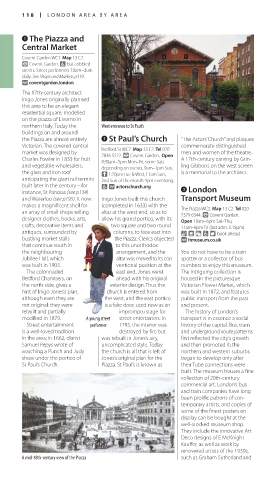
A mid-18th-century view of the Piazza such as Graham Sutherland and
118-119_EW_London.indd 118 21/03/17 2:20 pm

