


Page 154 - (DK Eyewitness) Travel Guide - London
P. 154
152 L ONDON AREA B Y AREA
6 St Paul’s Cathedral
Following the Great Fire of London in 1666, the medieval cathedral of
St Paul’s was left in ruins. The authorities turned to Christopher Wren
to rebuild it, but his ideas met with considerable resistance from the
conservative Dean and Chapter. Wren’s 1672 Great Model plan was
rejected and a watered-down plan was finally agreed in 1675. Wren’s
determination paid off, though: the cathedral is considered his
greatest masterpiece.
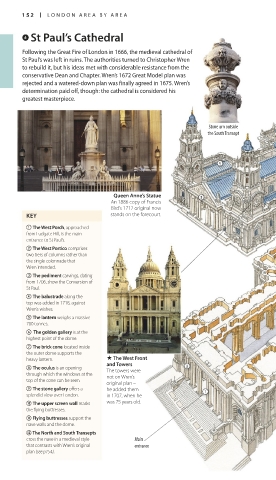
Stone urn outside
the South Transept
Queen Anne’s Statue
An 1886 copy of Francis
Bird’s 1712 original now
KEY stands on the forecourt.
1 The West Porch, approached
from Ludgate Hill, is the main
entrance to St Paul’s.
2 The West Portico comprises
two tiers of columns rather than
the single colonnade that
Wren intended.
3 The pediment carvings, dating
from 1706, show the Conversion of
St Paul.
4 The balustrade along the
top was added in 1718, against
Wren’s wishes.
5 The lantern weighs a massive
700 tonnes.
6 The golden gallery is at the
highest point of the dome.
7 The brick cone located inside
the outer dome supports the
heavy lantern. . The West Front
and Towers
8 The oculus is an opening The towers were
through which the windows at the not on Wren’s
top of the cone can be seen.
original plan –
9 The stone gallery offers a he added them
splendid view over London. in 1707, when he
0 The upper screen wall masks was 75 years old.
the flying buttresses.
q Flying buttresses support the
nave walls and the dome.
w The North and South Transepts
cross the nave in a medieval style Main
that contrasts with Wren’s original entrance
plan (see p154).
152-153_EW_London.indd 152 21/03/17 2:18 pm

