


Page 208 - (DK Eyewitness) Travel Guide - London
P. 208
206 L ONDON AREA B Y AREA
1 Natural History Museum
Life on Earth and the Earth itself are vividly explained at
the Natural History Museum. Using the latest interactive
techniques alongside traditional displays, exhibits tackle
such issues as how human beings evolved and how we
can safeguard our planet. The vast museum building . Mammals
is a masterpiece in itself. It opened in 1881 and was The life-size models are
a major attraction in this
designed by Alfred Waterhouse using revolutionary vast gallery.
Victorian building techniques. It is built on an iron
and steel framework concealed behind arches
and columns, richly decorated with sculptures of
plants and animals.
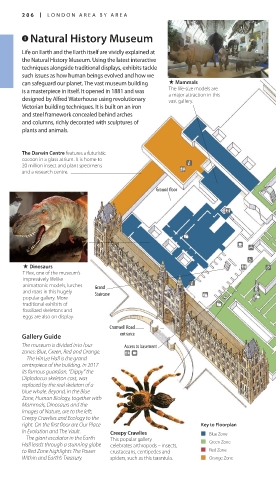
The Darwin Centre features a futuristic
cocoon in a glass atrium. It is home to
20 million insect and plant speci mens
and a research centre.
Ground floor
. Dinosaurs
T Rex, one of the museum’s
impressively lifelike
animatronic models, lurches Grand
and roars in this hugely Staircase
popular gallery. More
traditional exhibits of
fossilized skeletons and
eggs are also on display.
Cromwell Road
Gallery Guide entrance
The museum is divided into four Access to basement
zones: Blue, Green, Red and Orange. m -
The Hintze Hall is the grand
centrepiece of the building. In 2017
its famous guardian, “Dippy” the
Diplodocus skeleton cast, was
replaced by the real skeleton of a
blue whale. Beyond, in the Blue
Zone, Human Biology, together with
Mammals, Dinosaurs and the
Images of Nature, are to the left;
Creepy Crawlies and Ecology to the
right. On the first floor are Our Place Key to Floorplan
in Evolution and The Vault. Creepy Crawlies Blue Zone
The giant escalator in the Earth This popular gallery Green Zone
Hall leads through a stunning globe celebrates arthropods – insects,
to Red Zone highlights The Power crustaceans, centipedes and Red Zone
Within and Earth’s Treasury. spiders, such as this tarantula. Orange Zone
206-207_EW_London.indd 206 21/03/17 2:26 pm

