


Page 218 - (DK Eyewitness) Travel Guide - London
P. 218
216 L ONDON AREA B Y AREA
Exploring the V&A’s Collections (room 44). Covering the millennia
from 3000 BC to the present,
The sheer size of the V&A means you should plan your visit the impressive collection
carefully to avoid missing a highlight or an area of particular includes a giant Buddha’s head
interest. The following sections list highlights but are by from 700–900 AD, a huge yet
no means exhaustive. Be sure to visit the museum’s original elegant Ming canopied bed,
refreshment rooms off room 16a (one of which was designed and rare jade and ceramics.
Japanese art is concentrated
by William Morris), now being used again as a café. If the in the gallery in room 45, and
weather is good, don’t miss the John Madejski Garden. The is particularly notable for
Photog raphs galleries (rooms 38a and 100) display a changing lacquer, Samurai armour
selection of 300,000 photographs from 1856 to the present. and woodblock prints.
to delve even deeper into the
British Galleries
past by sporting a Tudor ruff or
A sequence of grand rooms viewing 3D images through a
starting on level 2 and Victorian stereoscope.
continuing on level 4 are
devoted to the luxurious British China, Japan and
Galleries. Covering design and
decorative arts from 1500 to South Asia Gilt copper ice chest
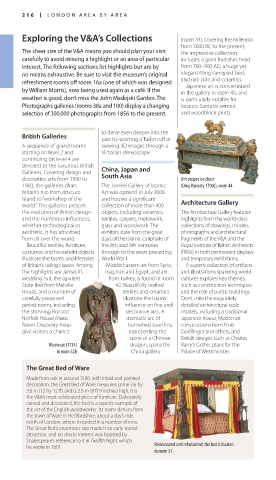
1900, the galleries chart The Jameel Gallery of Islamic (Qing Dynasty 1700s), room 44
Britain’s rise from obscure Art was opened in July 2006
island to “workshop of the and houses a significant
world”. The galleries present collection of more than 400 Architecture Gallery
the evolution of British design objects, including ceramics, The Architecture Gallery features
and the numerous influences, textiles, carpets, metalwork, highlights from the world-class
whether technological or glass and woodwork. The collections of drawings, models,
aesthetic, it has absorbed exhibits date from the great photographs and architectural
from all over the world. days of the Islamic caliphate of fragments of the V&A and the
Beautiful textiles, furniture, the 8th and 9th centuries Royal Institute of British Architects
costumes and household objects through to the years preceding (RIBA) in both permanent displays
illustrate the tastes and lifestyles World War I. and temporary exhibitions.
of Britain’s ruling classes. Among Middle Eastern art from Syria, A superb collection of artifacts
the highlights are James II’s Iraq, Iran and Egypt, and art and illustrations spanning world
wedding suit, the opulent from Turkey, is found in room cultures explores key themes,
State Bed from Melville 42. Beautifully crafted such as construction techniques
House, and a number of textiles and ceramics and the role of public buildings.
carefully preserved illustrate the Islamic Don’t miss the exquisitely
period rooms, including influence on fine and detailed architectural scale
the stunning Rococo decorative arts. A models, including a traditional
Norfolk House Music dramatic arc of Japanese house, Modernist
Room. Discovery Areas burnished steel fins, constructions from Ernö
give visitors a chance representing the Goldfinger and others, and
spine of a Chinese British designs such as Charles
Waistcoat (1734) dragon, spans the Barry’s Gothic plans for the
in room 52b China gallery Palace of Westminster.
The Great Bed of Ware
Made from oak in around 1590, with inlaid and painted
decoration, the Great Bed of Ware measures some 3.6 by
3.6 m (12 by 12 ft) and is 2.6 m (8 ft 9 inches) high. It is
the V&A’s most celebrated piece of furniture. Elaborately
carved and decorated, the bed is a superb example of
the art of the English woodworker. Its name derives from
the town of Ware in Hertfordshire, about a day’s ride
north of London, where it resided in a number of inns.
The Great Bed’s enormous size made it an early tourist
attraction, and no doubt interest was boosted by
Shakespeare’s reference to it in Twelfth Night, which
he wrote in 1601. Redecorated and refurbished, the bed is located
in room 57.
216-217_EW_London.indd 216 21/03/17 2:21 pm

