


Page 44 - (DK Eyewitness) Travel Guide - London
P. 44
42 INTRODUCING L ONDON
Remarkable Londoners
London has always been a gathering place for the most
prominent and influential people of the time – some
coming to London from other parts of Britain, some from
countries further afield, others born and bred Londoners.
All have left their mark on London by designing great and
lasting buildings, establishing institutions and traditions, or
immortalizing the city they know in art and literature. Most
of these figures have also influenced the wider world as a
result of their success.
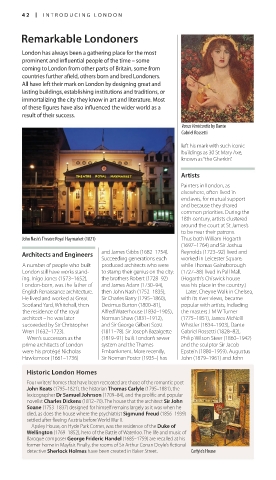
Venus Venticordia by Dante
Gabriel Rossetti
left his mark with such iconic
buildings as 30 St Mary Axe,
known as “the Gherkin”.
Artists
Painters in London, as
elsewhere, often lived in
enclaves, for mutual support
and because they shared
common priorities. During the
18th century, artists clustered
around the court at St James’s
to be near their patrons.
John Nash’s Theatre Royal Haymarket (1821) Thus both William Hogarth
(1697–1764) and Sir Joshua
Architects and Engineers and James Gibbs (1682–1754). Reynolds (1723–92) lived and
Succeeding generations each worked in Leicester Square,
A number of people who built produced architects who were while Thomas Gainsborough
London still have works stand to stamp their genius on the city: (1727–88) lived in Pall Mall.
ing. Inigo Jones (1573–1652), the brothers Robert (1728–92) (Hogarth’s Chiswick house
Londonborn, was the father of and James Adam (1730–94), was his place in the country.)
English Renaissance architecture. then John Nash (1752–1835), Later, Cheyne Walk in Chelsea,
He lived and worked at Great Sir Charles Barry (1795–1860), with its river views, became
Scotland Yard, Whitehall, then Decimus Burton (1800–81), popular with artists, including
the residence of the royal Alfred Waterhouse (1830–1905), the masters J M W Turner
architect – he was later Norman Shaw (1831–1912), (1775–1851), James McNeill
succeeded by Sir Christopher and Sir George Gilbert Scott Whistler (1834–1903), Dante
Wren (1632–1723). (1811–78). Sir Joseph Bazalgette Gabriel Rossetti (1828–82),
Wren’s successors as the (1819–91) built London’s sewer Philip Wilson Steer (1860–1942)
prime architects of London system and the Thames and the sculptor Sir Jacob
were his protégé Nicholas Embankment. More recently, Epstein (1880–1959). Augustus
Hawksmoor (1661–1736) Sir Norman Foster (1935–) has John (1879–1961) and John
Historic London Homes
Four writers’ homes that have been recreated are those of the romantic poet
John Keats (1795–1821), the historian Thomas Carlyle (1795–1881), the
lexicographer Dr Samuel Johnson (1709–84), and the prolific and popular
novelist Charles Dickens (1812–70). The house that the architect Sir John
Soane (1753–1837) designed for himself remains largely as it was when he
died, as does the house where the psychiatrist Sigmund Freud (1856–1939)
settled after fleeing Austria before World War II.
Apsley House, on Hyde Park Corner, was the residence of the Duke of
Wellington (1769–1852), hero of the Battle of Waterloo. The life and music of
Baroque composer George Frideric Handel (1685–1759) are recalled at his
former home in Mayfair. Finally, the rooms of Sir Arthur Conan Doyle’s fictional
detective Sherlock Holmes have been created in Baker Street. Carlyle’s House
042-043_EW_London.indd 42 21/03/17 2:25 pm

