


Page 9 - (DK Eyewitness) Travel Guide - London
P. 9
HOW T O USE THIS GUIDE 7
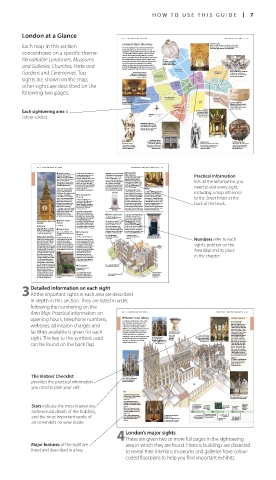
London at a Glance 48 INTRODUCING L ONDON L ONDON A T A GLANCE 49
Each map in this section London’s Best: Churches St Mary-le-Strand
Now on a traffic island, this ship-like church was built
by James Gibbs in 1714–17 to a lively Baroque design,
It is worth stopping to look at London’s churches and
going inside, if they are open. They have a special and features high windows and a rich interior.
concentrates on a specific theme: atmosphere unmatched elsewhere in the city, and they
can often yield an intimate glimpse of the past. Many
churches have replaced earlier buildings in a steady
Remarkable Londoners, Museums succession going back to pre-Christian times. Some began All Souls
life in outlying villages beyond London’s fortified centre,
and were absorbed into suburbs when the city expanded
This plaque comes from
a tomb in John Nash’s
and Galleries, Churches, Parks and in the 18th century. The memorials in the capital’s Regency church of 1824.
churches and church yards are a fascinating record of
local life, liberally peppered with famous names. A more
detailed overview of London churches is on pages 50–51.
Gardens and Ceremonies. Top Inigo Jones’s Classical church Bloomsbury Smithfield and St Mary Woolnoth
and Fitzrovia
The jewel-like interior of Nicholas
St Paul’s Covent Garden
Spitalfields
Hawksmoor’s small Baroque
Regent’s Park
was known as “the handsomest and Marylebone church (1716–27) appears larger
than the outside suggests.
sights are shown on the map; Holborn and
barn in England”.
the Inns of
Court
Soho and
other sights are described on the Square Covent The City
Trafalgar
Garden
and the
Strand
following two pages.
St Martin-in-the-Fields Piccadilly, Mayfair Southwark
James Gibbs’s church of and
and St James’s
1722–6 was originally South Kensington South Bankside
thought “too gay” for and Knightsbridge R I V E R T H A M E S Bank St Stephen Walbrook
Protestant worship. Wren was at his best with this
domed interior of 1672–7. Its
Whitehall carvings include Henry Moore’s
and St Paul’s austere modern altar.
Each sightseeing area is Westminster cathedral is the world’s
At 110 m (360 ft) high,
the dome of Wren’s
colour-coded. 0 kilometres 0.5 1 second-largest after
0 miles
St Peter’s in Rome.
Westminster Cathedral
The Italian-Byzantine Catholic
cathedral’s red-and-white brick
exterior conceals a rich interior
of multicoloured marbles.
Westminster Abbey
The famous abbey has the Temple Church Southwark Cathedral
Brompton Oratory most glorious medieval Built in the 12th and 13th centuries This largely 13th-century priory
This sumptuous Baroque architecture in London, and for the Knights Templar, this is one church was not designated a
church is decorated with highly impressive tombs of the few circular churches to cathedral until 1905. It has a
works by Italian artists. and monuments. survive in England. fine medieval choir.
78 L ONDON AREA B Y AREA WHITEHALL AND WESTMINSTER 79
3 Jewel Tower to Little Dean’s Yard, where the World War I, stands in the middle 0 Churchill
monks’ living quarters used to of Whitehall. On Remembrance War Rooms
Abingdon St SW1. Map 13 B5. be. Dean’s Yard is private Day every year – the Sunday Practical Information
Tel 020 7222 2219. 1 Westminster. property. It belongs to the Dean nearest 11 November – the Clive Steps, King Charles St SW1.
Open Apr–Sep: 10am–6pm daily; Oct and Chapter of Westminster and monarch and other dignitaries Map 13 B5. Tel 020 7930 6961.
10am–5pm daily; Nov–Mar: 1 Westminster, St James’s Park. lists all the information you
10am–4pm Sat & Sun. Closed 24 Dec– is close to Westminster School, place wreaths of red poppies on Open 9:30am–6pm daily (last adm:
1 Jan. & 7 ground floor only. = whose former pupils include the Cenotaph. This solemn 5pm). Closed 24–26 Dec, 1 Jan. &
∑ english-heritage.org.uk poet John Dryden and playwright ceremony, commemorating the 9 8 must book in advance 7 Telephones in the Map Room of the Cabinet need to visit every sight,
1918 armistice, honours those
Ben Jonson. Its scholars are, by
- = ∑ iwm.org.uk
This and Westminster Hall (see tradition, the first to who have died while serving in War Rooms
p76) are the only remaining acknowledge a new monarch. the armed forces (see pp58–9). This intriguing slice of 20th
vestiges of the old Palace of century history is a warren of complete with period furniture, including a map reference
Westminster. The tower was built rooms below the Government including Churchill’s desk,
in 1365 as a stronghold for 6 St Margaret’s Office building, where the War communi cations equipment
Edward III’s treasure and today Church Cabinet met during World War and maps for plotting military to the Street Finder at the
houses a fascinating exhibition, Parliament Sq SW1. Map 13 B5. II, when German bombs were strategy. The Churchill Museum
“Parliament Past and Present”, Tel 020 7654 4840. 1 Westminster. falling on London. The War is a multimedia exhibit recording
which relates the history of Open 9:30am–3:30pm Mon–Fri, Rooms include living quarters Churchill’s life and career, and a
Parliament. The display on the 9:30am–1:30pm Sat, 2–4:30pm Sun. for key ministers and military permanent display, Undercover: back of the book.
upper floor is devoted to the 5 11am Sun. ^ 7 via North Door leaders and a Cabinet Room, Life in Churchhill’s Bunker,
history of the tower itself. ∑ westminster-abbey.org/ where many strategic decisions features personal stories, objects
The tower served as the Weights st-margarets-church were taken. They are laid out as and interviews with those who
and Measures office from 1869 The Cenotaph they were when the war ended, worked in the War Rooms.
until 1938 and another small Overshadowed by the Abbey,
display relates to that era. this late 15thcentury church
Alongside are the remains of has long been a favoured venue 9 Downing Street some land near Whitehall Palace
the moat and a medieval quay. for political and society weddings, SW1. Map 13 B4. 1 Westminster. and built a street of houses.
such as Winston and Clementine Closed to the public. Four of these survive, though
George II gave No. 10 to Sir
The world’s most famous clock tower, which 4 Westminster Churchill’s. Although much Sir George Downing (1623–84) they are much altered. King
restored, the church retains some
houses Big Ben Abbey Tudor features, notably a stained spent part of his youth in the Robert Walpole in 1732. Since
glass window commemorating American colonies. He was then it has been the official
2 Big Ben the marriage of King Henry VIII and the second graduate from residence of the prime minister
See pp80–83.
Bridge St SW1. Map 13 C5. 1 West 5 Dean’s Yard his first wife, Catherine of Aragon. the nascent Harvard College and contains offices as well as a
before returning to fight for the
private apartment. In 1989, for
minster. 8 Elizabeth Tower is under Parliamentarians in the English security reasons, iron gates were
restoration until early 2020; tours are Broad Sanctuary SW1. Map 13 B5. 7 Parliament Civil War. In 1680, he bought erected at the Whitehall end.
suspended for the full duration. 1 Westminster. Buildings Closed to Square
Big Ben is not the name of the the public. SW1. Map 13 B5. 1 Westminster. No. 12, the Whips’ Office, Government policy is
is where political campaigns
decided in the Cabinet Room
worldfamous fourfaced clock in An arch near the west door are organized. at No. 10. The famous front door of No. 10
the 96 m (315 ft) tower that rises of the Abbey leads into this Laid out in the 1868 to provide Numbers refer to each
above the Houses of Parliament, secluded grassy square, a more open aspect for the new
but of the resonant 13.7tonne surrounded by a jumble of Houses of Parliament, the square
bell on which the hours are buildings from many different became Britain’s first official sight’s position on the
struck, thought to be named after periods. A medieval house on roundabout in 1926. Today it is
the Chief Commissioner of Works the east side has a distinctive hemmed in by heavy traffic.
Sir Benjamin Hall. Cast at White dormer window and backs on Statues of statesmen and soldiers Area Map and its place
chapel in 1858, it was the second are dominated by Winston
giant bell made for the clock, the Churchill in his greatcoat,
first having become cracked glowering at the House of
during a test ringing. The clock is Commons. On the north side, in the chapter.
the largest in Britain, its four dials Abraham Lincoln stands in front
7 m (23 ft) in diameter and the of the mockGothic Middlesex
minute hand 4.2 m (14 ft) long, Guildhall, completed in 1913.
made in hollow copper for light
ness. It has kept exact time for the No. 11 is the Chancellor of the
nation more or less contin uously 8 Cenotaph Exchequer’s official residence.
since it was first set in motion in Whitehall SW1. Map 13 B4.
May 1859, and has become a 1 Westminster.
symbol of Britain the world over.
The tower itself was renamed This suitably bleak and pale The prime minister
the Elizabeth Tower in 2012 in monument, completed in No. 10 is the official home of the entertains official
prime minister.
honour of Queen Elizabeth II in Entrance to the Abbey and cloisters from 1920 by Sir Edwin Lutyens to guests in the State
her Diamond Jubilee year. Dean’s Yard commemorate the dead of
Dining Room.
Detailed information on each sight
3All the important sights in each area are described
in depth in this section. They are listed in order,
following the number ing on the
Area Map. Practical information on 80 L ONDON AREA B Y AREA WHITEHALL AND WESTMINSTER 81
opening hours, telephone numbers, 4 Westminster Abbey VISITORS’ CHECKLIST
The Abbey is world-famous as the resting
Practical Information
websites, admission charges and place of Britain’s monarchs, and as the Broad Sanctuary SW1.
setting for coronations and other great
Map 13 B5. Tel 020 7222 5152.
∑ westminster-abbey.org
events, such as the marriage of Prince
Cloisters Open 9am–6pm daily.
facilities available is given for each William in 2011. Within its walls can be seen North/Main Entrance Abbey Open 9:30am–3:30pm
some of the most glorious examples of
Mon–Fri (to 6pm Wed), 9:30am–
medieval architecture in London. It also
3:30pm Sat (Sep–Apr: to 1:30pm
contains one of the most impressive The stonework here, . The Lady Chapel Sat). Admission at the final
such as this
entrance times given allow one
sight. The key to the symbols used collections of tombs and monuments in the . Flying Buttresses carving of a The chapel, consecrated in hour to explore. Closed for
world. Half national church, half national
The massive flying
dragon, is
special events; check website.
1516, has a superb vaulted
ceiling and choirstalls
Victorian.
Museum Open 10:30am–4pm
museum, the Abbey is part of British
buttresses help spread the
can be found on the back flap. national consciousness. great weight of the 31-m dating from 1512. Mon–Sat. & Pyx Chamber Open
10am–4pm Mon–Sat. College
(102-ft) high nave.
Garden Open Apr–Sep: 10am–
6pm Tue–Thu; Oct–Mar: 10am–
4pm Tue–Thu. Evensong: 5pm
Mon–Fri, 3pm Sat & Sun (May–
Aug: 5pm Sat). Queen’s Diamond
Jubilee Galleries Open due to
open 2018, check website ^ 7
limited. 8 9 - = Concerts.
Transport
1 St James’s Park, Westminster.
@ 3, 11, 12, 24, 29, 53, 70, 77,
87, 88, 109, 148, 159, 170, 211.
3 Victoria, Waterloo.
4 Westminster Pier.
The Visitors’ Checklist . West Front Towers
1745, were designed by
provides the practical information These towers, completed in
Nicholas Hawksmoor.
you need to plan your visit.
KEY
1 The North Transept has three . Chapter House
chapels on the east side containing This octagonal structure is worth
some of the Abbey’s finest seeing for its 13th-century tiles.
monuments.
2 St Edward’s Chapel houses
Edward the Confessor’s shrine and 2011 Prince
Stars indicate the most interesting the tombs of other English medieval 1050 New Benedic- Yevele begins 13th-century tile 1838 Queen William and
1376 Henry
Catherine
tine abbey church
monarchs.
from the Chapter
begun by Edward
Victoria’s
wedding
architectural details of the building, 3 The South Transept contains 1000 the Confessor 1200 rebuilding the nave 1400 1600 House 1800 coronation 2000 Middleton’s
“Poets’ Corner”, where memorials to
famous literary figures can be seen.
4 Museum 1269 Body of Edward the
and the most important works of 5 The Cloisters, built mainly in . The Nave viewed from begun to the designs Confessor moved to new 1745 West towers 1953 Most recent
1245 New church
the West End
completed
shrine in the Abbey
the 13th and 14th centuries, link the
coronation in the
Abbey church with the other At 10 m (35 ft) wide, the nave of Henry of Reyns 1540 Monastery Abbey: Elizabeth II’s
dissolved
art or exhibits on view inside. buildings. is comparatively narrow, but
it is the highest in England.
London’s major sights
4These are given two or more full pages in the sightseeing
Major features of the sight are area in which they are found. Historic buildings are dissected
listed and described in a key. to reveal their interiors; museums and galleries have colour-
coded floorplans to help you find important exhibits.
006-007_EW_London.indd 7 15/05/2017 15:37

