


Page 48 - Metal Hammer Issue 334 - UK (May 2020)
P. 48
JUDAS PRIEST


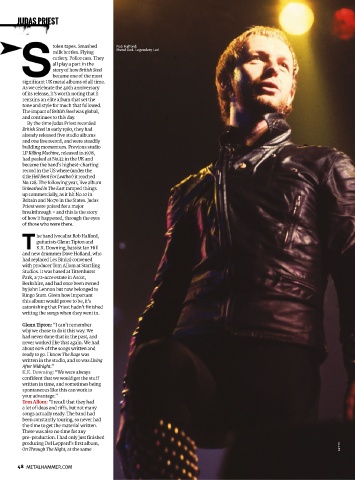
                          tolen tapes. Smashed           Rob Halford:
                          milk bottles. Flying           Metal God. Legendary Lad
                          cutlery. Police cars. They
                          all play a part in the
                          story of how British Steel
                          became one of the most
            significant UK metal albums of all time.
            As we celebrate the 40th anniversary
            of its release, it’s worth noting that it
            remains an elite album that set the
            tone and style for much that followed.
            The impact of British Steel was global,
            and continues to this day.
              By the time Judas Priest recorded
            British Steel in early 1980, they had
            already released five studio albums
            and one live record, and were steadily
            building momentum. Previous studio
            LP Killing Machine, released in 1978,
            had peaked at No.32 in the UK and
            became the band’s highest-charting
            record in the US where (under the
            title Hell Bent For Leather) it reached
            No.128. The following year, live album
            Unleashed In The East ramped things
            up commercially, as it hit No.10 in
            Britain and No.70 in the States. Judas
            Priest were poised for a major
            breakthrough – and this is the story
            of how it happened, through the eyes
            of those who were there.

                   he band (vocalist Rob Halford,
                   guitarists Glenn Tipton and
                   K.K. Downing, bassist Ian Hill
            and new drummer Dave Holland, who
            had replaced Les Binks) convened
            with producer Tom Allom at Startling
            Studios. It was based at Tittenhurst
            Park, a 72-acre estate in Ascot,
            Berkshire, and had once been owned
            by John Lennon but now belonged to
            Ringo Starr. Given how important
            this album would prove to be, it’s
            astonishing that Priest hadn’t finished
            writing the songs when they went in.

            Glenn Tipton: “I can’t remember
            why we chose to do it this way. We
            had never done that in the past, and
            never worked like that again. We had
            about 60% of the songs written and
            ready to go. I know The Rage was
            written in the studio, and so was Living
            After Midnight.”
            K.K. Downing: “We were always
            confident that we would get the stuff
            written in time, and sometimes being
            spontaneous like this can work to
            your advantage.”
            Tom Allom: “I recall that they had
            a lot of ideas and riffs, but not many
            songs actually ready. The band had
            been constantly touring, so never had
            the time to get the material written.
            There was also no time for any
            pre-production. I had only just finished
            producing Def Leppard’s first album,
            On Through The Night, at the same                                                                                                                        GETTY


          48  METALHAMMER.COM

