


Page 175 - (DK Eyewitness) Travel Guide - Sweden
P. 175
GO TLAND 173
reserve with steep cliffs, caves
such as “Stora Förvar”, moor-
land, leafy groves, and rare
flowers and birds. Here,
between the bare rocks in
May and June, the orchids
Adam och Eva (Dactylorhiza
sambucina) and Sankt Pers
nycklar (Orchis mascula) form
carpets of blooms. Sea birds
such as auks, gulls and eider
duck can be seen. Razorbills
lay their eggs among the
stones on the beach, while
guillemots prefer the shelves
of the steep cliffs.
A guided tour takes a couple
of hours and is included in
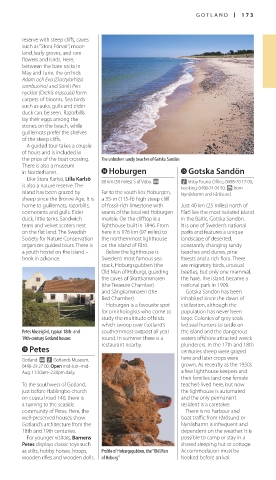
the price of the boat crossing. The unbroken sandy beaches of Gotska Sandön
There is also a museum
in Norderhamn. r Hoburgen t Gotska Sandön
Like Stora Karlsö, Lilla Karlsö 80 km (50 miles) S of Visby. @ n Visby Tourist Office, 0498-20 17 00;
is also a nature reserve. The booking: 0498-24 04 50. 4 from
island has been grazed by Far to the south lies Hoburgen, Nynäshamn and Fårösund.
sheep since the Bronze Age. It is a 35-m (115-ft) high steep cliff
home to guillemots, razorbills, of fossil-rich limestone with Just 40 km (25 miles) north of
cormorants and gulls. Eider seams of the local red Hoburgen Fårö lies the most isolated island
duck, little terns, Sandwich marble. On the clifftop is a in the Baltic, Gotska Sandön.
terns and velvet scoters nest lighthouse built in 1846. From It is one of Sweden’s national
on the flat land. The Swedish here it is 176 km (97 miles) to parks and features a unique
Society for Nature Conservation the northernmost lighthouse landscape of deserted,
organizes guided tours. There is on the island of Fårö. constantly changing sandy
a youth hostel on the island – Below the lighthouse is beaches and dunes, pine
book in advance. Sweden’s most famous sea forests and a rich flora. There
stack, Hoburgsgubben (the are migratory birds, unusual
Old Man of Hoburg), guarding beetles, but only one mammal,
the caves of Skattkammaren the hare. The island became a
(the Treasure Chamber) national park in 1909.
and Sängkammaren (the Gotska Sandön has been
Bed Chamber). inhabited since the dawn of
Hoburgen is a favourite spot civilization, although the
for ornithologists who come to population has never been
study the multitude of birds large. Colonies of grey seals
which swoop over Gotland’s led seal hunters to settle on
Petes Museigård, typical 18th- and southernmost outpost all year the island and the dangerous
19th-century Gotland houses round. In summer there is a waters offshore attracted wreck
restaurant nearby. plunderers. In the 17th and 18th
e Petes centuries sheep were grazed
Gotland. @ n Gotlands Museum, here and later crops were
0498-29 27 00. Open mid-Jun–mid- grown. As recently as the 1950s
Aug: 11:30am–2:30pm daily. a few lighthouse keepers and
their families (and one female
To the southwest of Gotland, teacher) lived here, but now
just before Hablingbo church the lighthouse is automated
on coastal road 140, there is and the only permanent
a turning to the seaside resident is a caretaker.
community of Petes. Here, the There is no harbour and
well-preserved houses show boat traffic from Fårösund or
Gotland’s architecture from the Nynäshamn is infrequent and
18th and 19th centuries. dependent on the weather. It is
For younger visitors, Barnens possible to camp or stay in a
Petes displays classic toys such shared sleeping hut or cottage.
as stilts, hobby horses, hoops, Profile of Hoburgsgubben, the “Old Man Accommodation must be
wooden rifles and wooden dolls. of Hoburg” booked before arrival.
172-173_EW_Sweden.indd 173 11/07/16 11:49 am

