


Page 332 - (DK Eyewitness) Travel Guide - Sweden
P. 332
330 SUR VIV AL GUIDE
Road Travel in Sweden
Distances within Sweden are huge, and in the rural areas
travelling in your own or a rented car is often the only way of
getting about. The well-developed road network varies in
quality, but the major roads are generally of a good standard.
State-run ferries operate a free service in the archipelagos.
Although traffic can be heavy in the cities in rush hour, it is
never on the same scale as in the UK and on the Continent,
and Swedish motorists are generally good-natured. For advice
on driving in Stockholm, see p332.
Road Standards Traffic Rules
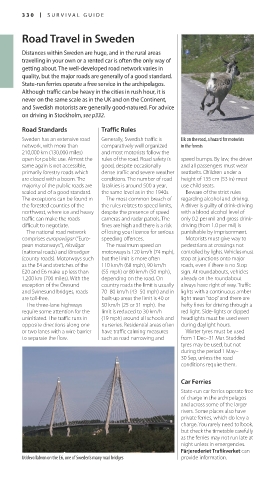
Sweden has an extensive road Generally, Swedish traffic is Elk on the road, a hazard for motorists
network, with more than comparatively well organized in the forests
210,000 km (130,000 miles) and most motorists follow the
open for public use. Almost the rules of the road. Road safety is speed bumps. By law, the driver
same again is not accessible, good, despite occasionally and all passengers must wear
primarily forestry roads which dense traffic and severe weather seatbelts. Children under a
are closed with a boom. The conditions. The number of road height of 135 cm (53 in) must
majority of the public roads are fatalities is around 500 a year, use child seats.
sealed and of a good standard. the same level as in the 1940s. Beware of the strict rules
The exceptions can be found in The most common breach of regarding alcohol and driving.
the forested counties of the the rules relates to speed limits, A driver is guilty of drinkdriving
northwest, where ice and heavy despite the presence of speed with a blood alcohol level of
traffic can make the roads cameras and radar patrols. The only 0.2 per mil and gross drink
difficult to negotiate. fines are high and there is a risk driving (from 1.0 per mil) is
The national road network of losing your licence for serious punishable by imprisonment.
comprises europavägar (“Euro speeding offences. Motorists must give way to
pean motorways”), riksvägar The maximum speed on pedestrians at crossings not
(national roads) and länsvägar motorways is 120 km/h (74 mph), controlled by lights. Vehicles must
(county roads). Motorways such but the limit is more often stop at junctions onto major
as the E4 and stretches of the 110 km/h (68 mph), 90 km/h roads, even if there is no Stop
E20 and E6 make up less than (55 mph) or 80 km/h (50 mph), sign. At roundabouts, vehicles
1,200 km (700 miles). With the depending on the road. On already on the roundabout
exception of the Öresund country roads the limit is usually always have right of way. Traffic
and Svinesund bridges, roads 70–80 km/h (43–50 mph) and in lights with a continuous amber
are tollfree. builtup areas the limit is 40 or light mean “stop” and there are
The threelane highways 50 km/h (25 or 31 mph). The hefty fines for driving through a
require some attention for the limit is reduced to 30 km/h red light. Sidelights or dipped
uninitiated. The traffic runs in (19 mph) around all schools and headlights must be used even
opposite directions along one nurseries. Residential areas often during daylight hours.
or two lanes with a wire barrier have traffic calming measures Winter tyres must be used
to separate the flow. such as road narrowing and from 1 Dec–31 Mar. Studded
tyres may be used, but not
during the period 1 May–
30 Sep, unless the road
conditions require them.
Car Ferries
Staterun car ferries operate free
of charge in the archipelagos
and across some of the larger
rivers. Some places also have
private ferries, which do levy a
charge. You rarely need to book,
but check the timetable carefully
as the ferries may not run late at
night unless in emergencies.
Färjerederiet Trafikverket can
Uddevallabron on the E6, one of Sweden’s many road bridges provide information.
330-331_EW_Sweden.indd 330 11/07/16 11:51 am
Eyewitness Travel LAYERS PRINTED:
Practical template “UK” LAYER
(Source v1.6)
Date 7th January 2013
Size 125mm x 217mm

