


Page 79 - (DK Eyewitness) Travel Guide - Sweden
P. 79
CIT Y 77
Ingmar Bergman
The playwright and producer Ingmar Bergman was born at
Östermalm in 1918. His long series of
masterly films have made him world-
famous, but he started his career in the
theatre. From 1963 to 1966 he was
Director of Kungliga Dramatiska Teatern.
His breakthrough as a film producer
came with Smiles of the Summer Night
(1955), and The Seventh Seal (1957) was a
cinematic milestone. Fanny and
Alexander (1982) was his last major film,
after which he wrote screenplays and
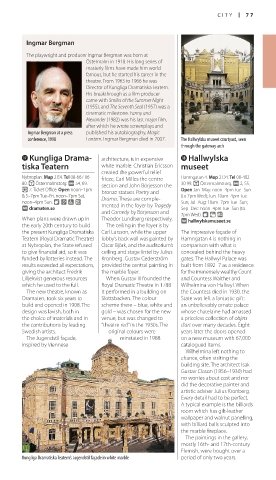
Ingmar Bergman at a press published his autobiography, Magic
conference, 1998 Lantern. Ingmar Bergman died in 2007. The Hallwylska museet courtyard, seen
through the gateway arch
u Kungliga Drama architecture, is in expensive i Hallwylska
tiska Teatern white marble. Christian Ericsson museet
created the powerful relief
Nybroplan. Map 2 E4. Tel 08-667 06 frieze, Carl Milles the centre Hamngatan 4. Map 2 D4. Tel 08-402
80. Östermalmstorg. @ 54, 69. section and John Börjesson the 30 99. Östermalmstorg. @ 2, 55.
v 7. Ticket Office: Open noon–1pm Open Jan–May: noon–4pm Tue–Sun
& 5–7pm Tue–Fri, noon–7pm Sat, bronze statues Poetry and (to 7pm Wed); Jun: 10am–4pm Tue–
Drama. These are comple-
noon–4pm Sun. 8 0 7 ^ Sun; Jul–Aug: 10am–7pm Tue–Sun;
∑ dramaten.se mented in the foyer by Tragedy Sep–Dec: noon–4pm Tue–Sun (to
and Comedy by Börjesson and 7pm Wed). 8 = ^
When plans were drawn up in Theodor Lundberg respectively. ∑ hallwylskamuseet.se
the early 20th century to build The ceiling in the foyer is by
the present Kungliga Dramatiska Carl Larsson, while the upper The impressive façade of
Teatern (Royal Dramatic Theatre) lobby’s back wall was painted by Hamngatan 4 is nothing in
at Nybroplan, the State refused Oscar Björk, and the auditorium’s comparison with what is
to give financial aid, so it was ceiling and stage lintel by Julius concealed behind the heavy
funded by lotteries instead. The Kronberg. Gustav Cederström gates. The Hallwyl Palace was
results exceeded all expectations, provided the central painting in built from 1892–7 as a residence
giving the architect Fredrik the marble foyer. for the immensely wealthy Count
Lilljekvist generous resources When Gustav III founded the and Countess Walther and
which he used to the full. Royal Dramatic Theatre in 1788 Wilhelmina von Hallwyl. When
The new theatre, known as it performed in a building on the Countess died in 1930, the
Dramaten, took six years to Slottsbacken. The colour State was left a fantastic gift:
build and opened in 1908. The scheme there – blue, white and an unbelievably ornate palace
design was lavish, both in gold – was chosen for the new whose chatelaine had amassed
the choice of materials and in venue, but was changed to a priceless collection of objets
the contributions by leading “theatre red” in the 1930s. The d’art over many decades. Eight
Swedish artists. original colours were years later the doors opened
The Jugendstil façade, reinstated in 1988. on a new museum with 67,000
inspired by Viennese catalogued items.
Wilhelmina left nothing to
chance, often visiting the
building site. The architect Isak
Gustav Clason (1856–1930) had
no worries about cost and nor
did the decorative painter and
artistic adviser Julius Kronberg.
Every detail had to be perfect.
A typical example is the billiards
room which has gilt-leather
wall paper and walnut panelling,
with billiard balls sculpted into
the marble fireplace.
The paintings in the gallery,
mostly 16th- and 17th-century
Flemish, were bought over a
Kungliga Dramatiska Teatern’s Jugendstil façade in white marble period of only two years.
076-077_EW_Sweden.indd 77 11/07/16 11:43 am

