


Page 88 - (DK Eyewitness) Travel Guide - Sweden
P. 88
86 ST OCKHOLM AREA B Y AREA
7 Nationalmuseum
The Nationalmuseum is a landmark on the southern
side of Blasieholmen. The location by the Strömmen
channel inspired the 19th-century German architect
August Stüler to design a building in the Venetian and
Florentine Renaissance styles.
Completed in 1866, the museum houses Sweden’s largest
art collection, with some 16,000 classic paintings and sculp-
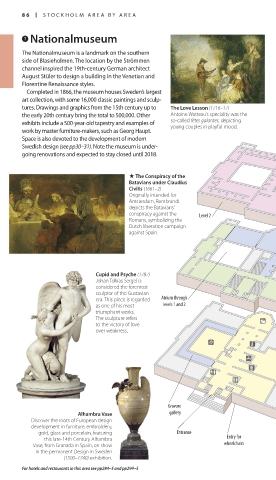
tures. Drawings and graphics from the 15th century up to The Love Lesson (1716–17)
the early 20th century bring the total to 500,000. Other Antoine Watteau’s speciality was the
exhibits include a 500-year-old tapestry and examples of so-called fêtes galantes, depicting
young couples in playful mood.
work by master furniture-makers, such as Georg Haupt.
Space is also devoted to the development of modern
Swedish design (see pp30–31). Note the museum is under-
going renovations and expected to stay closed until 2018.
. The Conspiracy of the
Batavians under Claudius
Civilis (1661–2)
Originally intended for
Amsterdam, Rembrandt
depicts the Batavians’
conspiracy against the Level 2
Romans, symbolizing the
Dutch liberation campaign
against Spain.
Cupid and Psyche (1787)
Johan Tobias Sergel is
considered the foremost
sculptor of the Gustavian
era. This piece is regarded Atrium through
as one of his most levels 1 and 2
triumphant works.
The sculpture refers
to the victory of love
over weakness.
Gravure
Alhambra Vase gallery
Discover the roots of European design
development in furniture, embroidery,
gold, glass and porcelain, featuring Entrance
this late-14th Century Alhambra Entry for
Vase, from Granada in Spain, on show wheel chairs
in the permanent Design in Sweden
(1500–1740) exhibition.
For hotels and restaurants in this area see pp284–5 and pp294–5
086-087_EW_Sweden.indd 86 11/07/16 11:48 am
Eyewitness Travel LAYERS PRINTED:
Starsight template “UK” LAYER
(Source v2.7)
Date 24th April 2013
Size 125mm x 217mm

