


Page 96 - (DK Eyewitness) Travel Guide - Sweden
P. 96
94 ST OCKHOLM AREA B Y AREA
4 Nordiska museet
Resembling an extravagant Renaissance castle,
Nordiska museet portrays everyday life in
Sweden from the 1520s to the present day.
It was created by Artur Hazelius (1833–1901),
who was also the founder of Skansen (see p98).
In 1872, he started to collect objects which
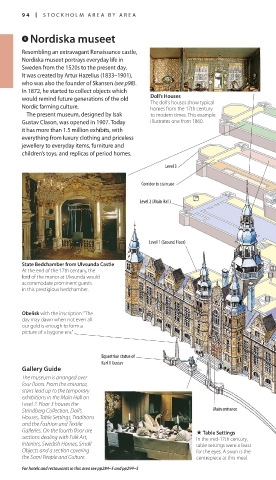
would remind future generations of the old Doll’s Houses
The doll’s houses show typical
Nordic farming culture. homes from the 17th century
The present museum, designed by Isak to modern times. This example
Gustav Clason, was opened in 1907. Today illustrates one from 1860.
it has more than 1.5 million exhibits, with
everything from luxury clothing and priceless
jewellery to everyday items, furniture and
children’s toys, and replicas of period homes.
Level 3
Corridor to staircase
Level 2 (Main Hall)
Level 1 (Ground Floor)
State Bedchamber from Ulvsunda Castle
At the end of the 17th century, the
lord of the manor at Ulvsunda would
accommodate prominent guests
in this prestigious bedchamber.
Obelisk with the inscription: “The
day may dawn when not even all
our gold is enough to form a
picture of a bygone era.”
Equestrian statue of
Karl X Gustav
Gallery Guide
The museum is arranged over
four floors. From the entrance,
stairs lead up to the temporary
exhibitions in the Main Hall on
Level 2. Floor 3 houses the
Strindberg Collection, Doll’s Main entrance
Houses, Table Settings, Traditions
and the Fashion and Textile
Galleries. On the fourth floor are . Table Settings
sections dealing with Folk Art, In the mid-17th century,
Interiors, Swedish Homes, Small table settings were a feast
Objects and a section covering for the eyes. A swan is the
the Sami People and Culture. centrepiece at this meal.
For hotels and restaurants in this area see pp284–5 and pp294–5
094-095_EW_Sweden.indd 94 11/07/16 11:43 am

