


Page 72 - World of Animals - Issue #33
P. 72
Explore the Earth


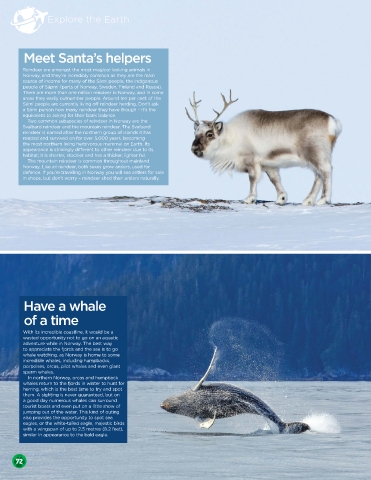
              Meet Santa’s helpers


             Reindeer are amongst the most magical-looking animals in
             Norway, and they’re incredibly common as they are the main
             source of income for many of the Sámi people, the indigenous
             people of Sápmi (parts of Norway, Sweden, Finland and Russia).
             There are more than one million reindeer in Norway, and in some
             areas they easily outnumber people. Around ten per cent of the
             Sámi people are currently living off reindeer herding. Don’t ask
             a Sámi person how many reindeer they have though – it’s the
             equivalent to asking for their bank balance.
               Two common subspecies of reindeer in Norway are the
             Svalbard reindeer and the mountain reindeer. The Svalbard
             reindeer is named after the northern group of islands it has
             resided and survived on for over 5,000 years, becoming
             the most northern living herbivorous mammal on Earth. Its
             appearance is strikingly different to other reindeer due to its
             habitat; it is shorter, stockier and has a thicker, lighter fur.
               The mountain reindeer is common throughout mainland
             Norway. Like all reindeer, both sexes grow antlers, used for
             defence. If you’re travelling in Norway you will see antlers for sale
             in shops, but don’t worry – reindeer shed their antlers naturally.


              Have a whale

              of a time


             With its incredible coastline, it would be a
             wasted opportunity not to go on an aquatic
             adventure while in Norway. The best way
             to appreciate the fjords and the sea is to go
             whale watching, as Norway is home to some
             incredible whales, including humpbacks,
             porpoises, orcas, pilot whales and even giant
             sperm whales.
               In northern Norway, orcas and humpback
             whales return to the fjords in winter to hunt for
             herring, which is the best time to try and spot
             them. A sighting is never guaranteed, but on
             a good day numerous whales can surround
             tourist boats and even put on a little show of
             jumping out of the water. This kind of outing
             also provides the opportunity to spot sea
             eagles, or the white-tailed eagle, majestic birds
             with a wingspan of up to 2.5 metres (8.2 feet),
             similar in appearance to the bald eagle.


           72

