


Page 23 - Sports Illustrated Kids (October 2018)
P. 23
FROM THE PAGES OF


                                                                                                                              AUGUST 27, 2018


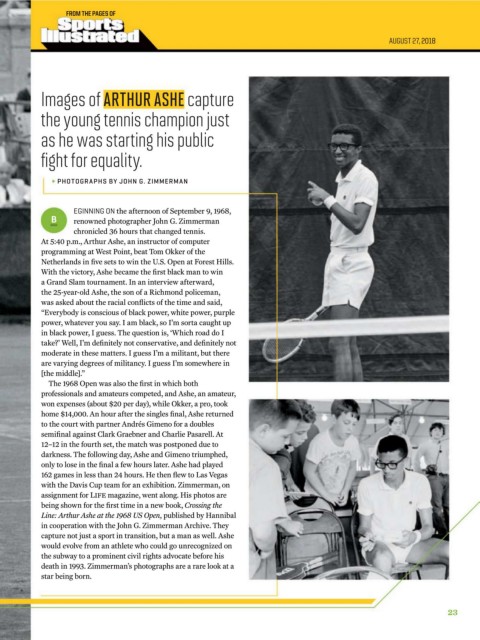
              Images of Arthur Ashe capture


              the young tennis champion just


              as he was starting his public


              ight for equality.


                   PHOTOGRAPHS BY JOHN G. ZIMMERMAN


                         EGINNING ON the afternoon of September 9, 1968,
                 B       renowned photographer John G. Zimmerman
                         chronicled 36 hours that changed tennis.
              At 5:40 p.m., Arthur Ashe, an instructor of computer
              programming at West Point, beat Tom Okker of the
              Netherlands in five sets to win the U.S. Open at Forest Hills.
              With the victory, Ashe became the first black man to win
              a Grand Slam tournament. In an interview afterward,
              the 25-year-old Ashe, the son of a Richmond policeman,
              was asked about the racial conflicts of the time and said,
              “Everybody is conscious of black power, white power, purple
              power, whatever you say. I am black, so I’m sorta caught up
              in black power, I guess. The question is, ‘Which road do I
              take?’ Well, I’m definitely not conservative, and definitely not
              moderate in these matters. I guess I’m a militant, but there
              are varying degrees of militancy. I guess I’m somewhere in

              [the middle].”
                 The 1968 Open was also the first in which both
              professionals and amateurs competed, and Ashe, an amateur,
              won expenses (about $20 per day), while Okker, a pro, took
              home $14,000. An hour after the singles final, Ashe returned
              to the court with partner Andrés Gimeno for a doubles
              semifinal against Clark Graebner and Charlie Pasarell. At
              12–12 in the fourth set, the match was postponed due to
              darkness. The following day, Ashe and Gimeno triumphed,
              only to lose in the final a few hours later. Ashe had played
              162 games in less than 24 hours. He then flew to Las Vegas
              with the Davis Cup team for an exhibition. Zimmerman, on
              assignment for Life magazine, went along. His photos are
              being shown for the first time in a new book, Crossing the
              Line: Arthur Ashe at the 1968 US Open, published by Hannibal
              in cooperation with the John G. Zimmerman Archive. They
              capture not just a sport in transition, but a man as well. Ashe
              would evolve from an athlete who could go unrecognized on
              the subway to a prominent civil rights advocate before his

              death in 1993. Zimmerman’s photographs are a rare look at a
              star being born.


                                                                                                                                                 23

