


Page 45 - Lighting & Sound America (December 2019) Magazine
P. 45
he says, “gives me a degree of flexibility that helps me to
                                                                       do my job. This is my first PRG show, and they were really
                                                                       great in getting us the gear. Also, Asher Robinson [produc-
                                                                       tion video engineer] is a big fan of Barnfind Technologies;
                                                                       you create a fiber distribution system for the room and
                                                                       then, utilizing their StageBox, you can customize which
                                                                       type of signal you are receiving at each location: SDI, net-
                                                                       work, audio, control, etc.”
                                                                         In terms of the show’s network, Sugg adds, “The vast
                                                                       majority of the cues are done through the lighting console,
                                                                       although some are done with SMPTE time code.” It’s
                                                                       another example of the interconnectedness that makes the
                                                                       design work.

                                                                       Lighting
                                                                       Just as Thompson and Sugg had to find a way of render-
                                                                       ing so many locations, Poet had to come up with a system
                                                                       that could deliver the requisite time-of-day looks along
                                                                       with high-energy rock concert eye candy. Indeed, he
                                                                       notes, Tina “is written as much as a play as it is a musi-
                                                                       cal.” He, too, invokes the term “memory play,” which
                                                                       explains the graceful way that the lighting design cuts
                                                                       across time, space, and performance styles, from natura-
                                                                       listic kitchen interiors to the mad excess of the concert in
                                                                       Brazil. The action, he adds, “has to be fluid because what
                                                                       we’re seeing are, essentially, fragments of her memory.”
                                                                       He adds, “Every scene had to have its own shape,” for
                                                                       which he had to “build a rig of possibilities.”
                                                                         Poet adds that, just as Thompson’s scenery, which he
                                                                       describes as “not a black box but a magic box,” can
                                                                       “shape and scale and frame the space,” the lighting con-
                                                                       stantly pulls focus to highlight the actors. His design also
                                                                       takes into account the fact that “many of the stage pic-
                                                                       tures are balanced between lighting and video.”
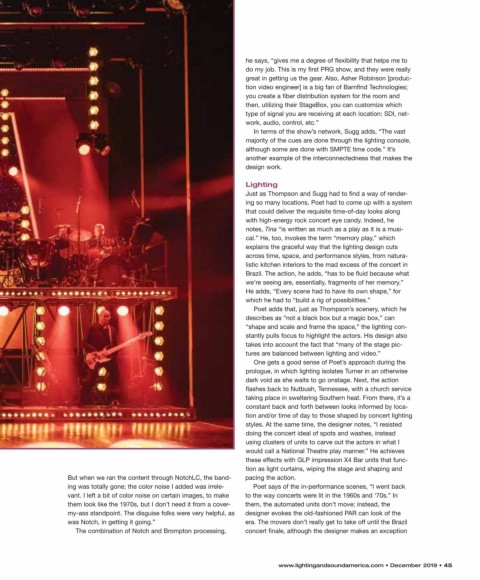
                                                                         One gets a good sense of Poet’s approach during the
                                                                       prologue, in which lighting isolates Turner in an otherwise
                                                                       dark void as she waits to go onstage. Next, the action
                                                                       flashes back to Nutbush, Tennessee, with a church service
                                                                       taking place in sweltering Southern heat. From there, it’s a
                                                                       constant back and forth between looks informed by loca-
                                                                       tion and/or time of day to those shaped by concert lighting
                                                                       styles. At the same time, the designer notes, “I resisted
                                                                       doing the concert ideal of spots and washes, instead
                                                                       using clusters of units to carve out the actors in what I
                                                                       would call a National Theatre play manner.” He achieves
                                                                       these effects with GLP impression X4 Bar units that func-
                                                                       tion as light curtains, wiping the stage and shaping and
                    But when we ran the content through NotchLC, the band-  pacing the action.
                    ing was totally gone; the color noise I added was irrele-  Poet says of the in-performance scenes, “I went back
                    vant. I left a bit of color noise on certain images, to make  to the way concerts were lit in the 1960s and ‘70s.” In
                    them look like the 1970s, but I don’t need it from a cover-  them, the automated units don’t move; instead, the
                    my-ass standpoint. The disguise folks were very helpful, as  designer evokes the old-fashioned PAR can look of the
                    was Notch, in getting it going.”                   era. The movers don’t really get to take off until the Brazil
                      The combination of Notch and Brompton processing,  concert finale, although the designer makes an exception


                                                                                www.lightingandsoundamerica.com • December 2019 • 45

