


Page 364 - (DK Eyewitness) Travel Guide - Paris
P. 364
362 SUR VIV AL GUIDE
Personal Security and Health
While safety concerns have hindered tourism after much-
mediatized events in recent years, Paris is as safe as ever.
Expect security screenings entering most museums and
monuments, even churches, and armed guards patrolling
even the tiniest streets. As in all major cities, common sense
is usually sufficient to avoid problems with street crime in
general. If you fall sick during your visit, pharmacists are an
excellent source of advice – they can diagnose many health
problems and suggest appropriate treatment. For more
serious medical help, someone at the emergency numbers
in the box below will be able to deal with most enquiries.
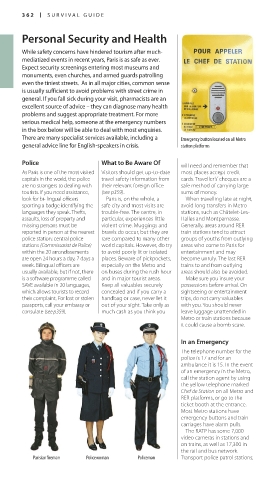
There are many specialist services available, including a Emergency button located on all Metro
general advice line for English-speakers in crisis. station platforms
Police What to Be Aware Of
will need and remember that
As Paris is one of the most visited Visitors should get up-to-date most places accept credit
capitals in the world, the police travel safety information from cards. Traveller’s’ cheques are a
are no strangers to dealing with their relevant foreign office safe method of carrying large
tourists. If you need assistance, (see p359). sums of money.
look for bi- lingual officers Paris is, on the whole, a When travelling late at night,
sporting a badge identifying the safe city and most visits are avoid long transfers in Metro
languages they speak. Thefts, trouble-free. The centre, in stations, such as Châtelet-Les-
assaults, loss of property and particular, experiences little Halles and Montparnasse.
missing persons must be violent crime. Muggings and Generally, areas around RER
reported in person at the nearest brawls do occur, but they are train stations tend to attract
police station; central police rare compared to many other groups of youths from outlying
stations (Commissariat de Police) world capitals. However, do try areas who come to Paris for
within the 20 arrondissements to avoid poorly lit or isolated entertainment and may
are open 24 hours a day, 7 days a places. Beware of pickpockets, become unruly. The last RER
week. Bilingual officers are especially on the Metro and trains to and from outlying
usually available, but if not, there on buses during the rush hour areas should also be avoided.
is a software programme called and in major tourist areas. Make sure you insure your
SAVE available in 20 languages, Keep all valuables securely possessions before arrival. On
which allows tourists to record concealed and if you carry a sightseeing or entertainment
their complaint. For lost or stolen handbag or case, never let it trips, do not carry valuables
passports, call your embassy or out of your sight. Take only as with you. You should never
consulate (see p359). much cash as you think you leave luggage unattended in
Metro or train stations because
it could cause a bomb scare.
In an Emergency
The telephone number for the
police is 17 and for an
ambulance it is 15. In the event
of an emergency in the Metro,
call the station agent by using
the yellow telephone marked
Chef de Station on all Metro and
RER platforms, or go to the
ticket booth at the entrance.
Most Metro stations have
emergency buttons and train
carriages have alarm pulls.
The RATP has some 7,000
video cameras in stations and
on trains, as well as 17,300 in
the rail and bus network.
Parisian fireman Policewoman Policeman Transport police patrol stations,
362-363_EW_Paris.indd 362 03/04/17 10:50 am
Eyewitness Travel LAYERS PRINTED:
Practical template “UK” LAYER
(Source v1.1)
Date 13th August 2012
Size 125mm x 217mm

