


Page 259 - (DK Eyewitness) Travel Guide - Hungary
P. 259
THE GREA T PLAIN 257
s Szatmárcseke
church, was built around 1480.
Partially destroyed during raids 27 km (17 miles) southeast of
by Vlachs (Romanians) in 1587, Vásárosnamény. Road Map G2.
it was left to rot until 1720, when * 1,600. @ from Vásárosnamény,
it was restored in the Baroque Fehérgyarmat.
style by the Minorite Order.
The István Báthory Museum At Szatmárcseke, the Protestant
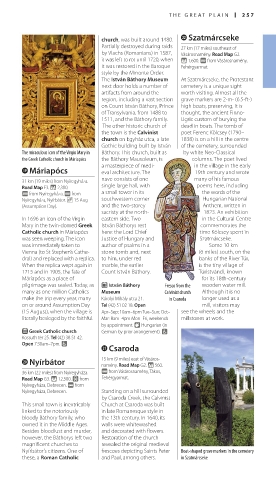
next door holds a number of cemetery is a unique sight
artifacts from around the worth visiting. Almost all the
region, including a vast section grave markers are 2-m- (6.5-ft-)
on Count István Báthory, Prince high boats, preserving, it is
of Transylvania, from 1488 to thought, the ancient Finno-
1511, and the Báthory family. Ugric custom of burying the
The other historic church of dead in boats. The tomb of
the town is the Calvinist poet Ferenc Kölcsey (1790–
church on Egyház utca, a late 1838) is on a hill in the centre
Gothic building built by István of the cemetery, surrounded
The miraculous icon of the Virgin Mary in Báthory. This church, built as by white Neo-Classical
the Greek Catholic church in Máriapócs the Báthory Mauso leum, is columns. The poet lived
a master piece of medi- in the village in the early
o Máriapócs eval archi tecture. The 19th century and wrote
nave consists of one many of his famous
31 km (19 miles) from Nyíregyháza.
Road Map F3. * 2,300. single large hall, with poems here, including
@ from Nyíregyháza. @ from a small tower in its the words of the
Nyíregy háza, Nyírbátor. _ 15 Aug southwestern corner Hungarian National
(Assump tion Day). and the two-storey Anthem, written in
sacristy at the north- 1823. An exhibition
In 1696 an icon of the Virgin eastern side. Two in the Cultural Centre
Mary in the twin-domed Greek István Báthorys rest commemorates the
Catholic church in Máriapócs here: the Lord Chief time Kölcsey spent in
was seen weeping. The icon Justice of Hungary and Szatmárcseke.
was immediately taken to author of psalms in a Some 10 km
Vienna (to St Stephen’s Cathe- stone tomb and, next (6 miles) south, on the
dral) and replaced with a replica. to him, under red banks of the River Túr,
When the replica wept again in marble, the earlier is the tiny village of
1715 and in 1905, the fate of Count István Báthory. Túristvándi, known
Máriapócs as a place of for its 18th-century
pilgrimage was sealed. Today, as E István Báthory Fresco from the wooden water mill.
many as one million Catholics Museum Calvinist church Although it is no
make the trip every year, many Károlyi Mihály utca 21. in Csaroda longer used as a
on or around Assumption Day Tel (42) 51 02 18. Open mill, visitors may
(15 August), when the village is Apr–Sep: 10am–6pm Tue–Sun; Oct– see the wheels and the
literally besieged by the faithful. Mar: 8am–4pm Mon–Fri, weekends millstones at work.
by appointment. 8 Hungarian (in
E Greek Catholic church German by prior arrangement). 7
Kossuth tér 25. Tel (42) 38 51 42.
Open 7:30am–7pm. 7
a Csaroda
p Nyírbátor 15 km (9 miles) east of Vásáros-
namény. Road Map G2. * 560.
36 km (22 miles) from Nyíregyháza. @ from Vásárosnamény, Tákos,
Road Map G3. * 12,500. £ from Fehérgyarmat.
Nyíregyháza, Debrecen. @ from
Nyíregyháza, Debrecen. Standing on a hill surrounded
by Csaroda Creek, the Calvinist
This small town is inextricably Church at Csaroda was built
linked to the notoriously in late Romanesque style in
bloody Báthory family, who the 13th century. In 1640, its
owned it in the Middle Ages. walls were whitewashed
Besides bloodlust and murder, and decorated with flowers.
however, the Báthorys left two Restoration of the church
magnificent churches to revealed the original medieval
Nyírbátor’s citizens. One of frescoes depicting Saints Peter Boat-shaped grave markers in the cemetery
these, a Roman Catholic and Paul, among others. in Szatmárcseke
256-257_EW_Hungary.indd 257 18/09/17 3:38 pm

