


Page 282 - Tagalog for Beginners: An Introduction to Filipino, the National Language of the Philippines
P. 282
(literally,  Will  sing  with  marker  Maria  plural  marker  Juan,  Pedro,  and
                    Clara.)


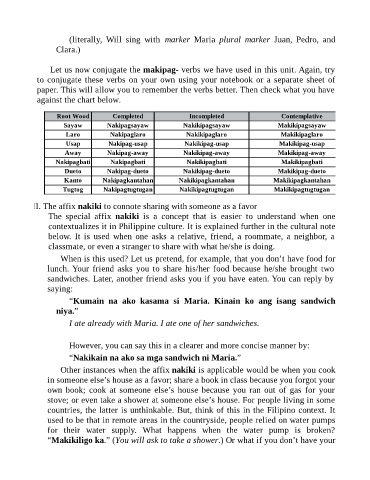
                  Let us now conjugate the makipag- verbs we have used in this unit. Again, try
             to conjugate these verbs on your own using your notebook or a separate sheet of
             paper. This will allow you to remember the verbs better. Then check what you have
             against the chart below.


                    Root Wood         Completed                 Incompleted                   Contemplative
                      Sayaw         Nakipagsayaw              Nakikipagsayaw                 Makikipagsayaw
                       Laro          Nakipaglaro               Nakikipaglaro                  Makikipaglaro
                       Usap          Nakipag-usap             Nakikipag-usap                 Makikipag-usap
                      Away           Nakipag-away             Nakikipag-away                 Makikipag-away
                   Nakipagbati        Nakipagbati              Nakikipagbati                  Makikipagbati
                      Dueto         Nakipag-dueto             Nakikipag-dueto                Makikipag-dueto
                      Kanto        Nakipagkantahan          Nakikipagkantahan              Makikipagkantahan
                      Tugtog       Nakipagtugtugan          Nakikipagtugtugan               Makikipagtugtugan

            II. The affix nakiki to connote sharing with someone as a favor
                 The  special  affix  nakiki  is  a  concept  that  is  easier  to  understand  when  one
                 contextualizes it in Philippine culture. It is explained further in the cultural note
                 below.  It  is  used  when  one  asks  a  relative,  friend,  a  roommate,  a  neighbor,  a
                 classmate, or even a stranger to share with what he/she is doing.

                     When is this used? Let us pretend, for example, that you don’t have food for
                 lunch. Your friend asks you to share his/her food because he/she brought two
                 sandwiches. Later, another friend asks you if you have eaten. You can reply by
                 saying:
                        “Kumain  na  ako  kasama  si  Maria.  Kinain  ko  ang  isang  sandwich

                    niya.”
                        I ate already with Maria. I ate one of her sandwiches.


                        However, you can say this in a clearer and more concise manner by:
                        “Nakikain na ako sa mga sandwich ni Maria.”

                     Other instances when the affix nakiki is applicable would be when you cook
                 in someone else’s house as a favor; share a book in class because you forgot your
                 own book; cook at someone else’s house because you ran out of gas for your
                 stove; or even take a shower at someone else’s house. For people living in some
                 countries, the latter is unthinkable. But, think of this in the Filipino context. It
                 used to be that in remote areas in the countryside, people relied on water pumps
                 for  their  water  supply.  What  happens  when  the  water  pump  is  broken?
                 “Makikiligo ka.” (You will ask to take a shower.) Or what if you don’t have your

