


Page 29 - Tagalog for Beginners: An Introduction to Filipino, the National Language of the Philippines
P. 29
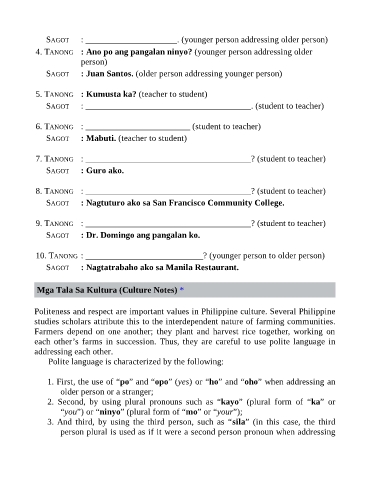
SAGOT       : _____________________. (younger person addressing older person)
             4. TANONG : Ano po ang pangalan ninyo? (younger person addressing older
                            person)

                SAGOT       : Juan Santos. (older person addressing younger person)


             5. TANONG : Kumusta ka? (teacher to student)

                SAGOT       : ______________________________________. (student to teacher)

             6. TANONG : ________________________ (student to teacher)

                SAGOT       : Mabuti. (teacher to student)


             7. TANONG : ______________________________________? (student to teacher)

                SAGOT       : Guro ako.


             8. TANONG : ______________________________________? (student to teacher)

                SAGOT       : Nagtuturo ako sa San Francisco Community College.

             9. TANONG : ______________________________________? (student to teacher)

                SAGOT       : Dr. Domingo ang pangalan ko.


             10. TANONG : ___________________________? (younger person to older person)

                SAGOT       : Nagtatrabaho ako sa Manila Restaurant.


             Mga Tala Sa Kultura (Culture Notes) *


            Politeness and respect are important values in Philippine culture. Several Philippine
            studies scholars attribute this to the interdependent nature of farming communities.
            Farmers  depend  on  one  another;  they  plant  and  harvest  rice  together,  working  on
            each other’s farms in succession. Thus, they are careful to use polite language in
            addressing each other.
                 Polite language is characterized by the following:


                 1. First, the use of “po” and “opo” (yes) or “ho” and “oho” when addressing an
                     older person or a stranger;
                 2.  Second,  by  using  plural  pronouns  such  as  “kayo”  (plural  form  of  “ka”  or
                     “you”) or “ninyo” (plural form of “mo” or “your”);
                 3. And  third,  by  using  the  third  person,  such  as  “sila”  (in  this  case,  the  third
                     person plural is used as if it were a second person pronoun when addressing

