


Page 113 - (DK Eyewitness) Travel Guide - Chicago
P. 113
MUSEUM OF SCIENCE AND INDUSTR Y 111
From Plaster to Stone
Architect Charles B. Atwood (see p32) based his design of this majestic
building – built as a temporary structure for the 1893 World’s Fair and,
today, the only surviving building from the fair – on classical Greek
models. Over 270 columns and 24 caryatids, weighing 6 tons each,
grace the exterior. Covered in plaster, with a roof of skylights, the
building deteriorated badly after the fair. The Field Museum (see pp88–
91) occupied it briefly, until 1920. The building then sat in a state of
disrepair until the mid-1920s, when Julius Rosenwald, chairman of
Sears, Roebuck and Co., campaigned to save it and founded the
museum, donating millions of dollars to a massive reconstruction
effort. Exterior plaster was replaced with 28,000 tons of limestone and
marble in an 11-year renovation. The Museum of Science and Industry
opened in 1933, in time for the Century of Progress World’s Exposition.
Fast machines in the museum’s
transportation zone
The Human Body
A large, interactive exhibit
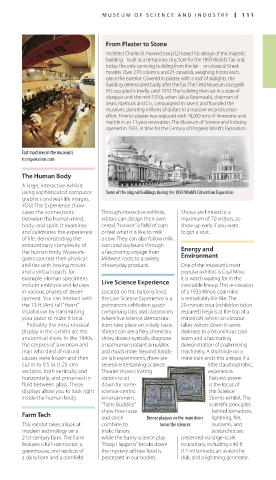
using sophisticated computer Some of the original buildings during the 1893 World’s Columbian Exposition
graphics and real-life images,
YOU! The Experience show-
cases the connections Through interactive exhibits, Shows are limited to a
between the human mind, visitors can design their own maximum of 70 visitors, so
body, and spirit. It examines cereal, “harvest” a field of corn show up early if you want
and celebrates the experience or feel what it is like to milk to get a seat.
of life, demonstrating the a cow. They can also follow milk,
extraordinary complexity of corn and soybeans through Energy and
the human body. Museum- a fascinating voyage from
goers can test their physical Midwest roots to a variety Environment
abilities with boxing moves of everyday products. One of the museum’s most
and a virtual coach, for popular exhibits is Coal Mine.
example. Human specimens It is worth waiting for in the
include embryos and fetuses Live Science Experience inevitable lineup. This re-creation
in various phases of devel- Located on the balcony level, of a 1933 Illinois coal mine
opment. You can interact with the Live Science Experience is a is remarkably life-like. The
the 13 ft (4m) tall “Heart” permanent exhibition space 20-minute tour (exhibition ticket
installation by transmitting comprising labs and classrooms required) begins at the top of a
your pulse to make it beat. where live science demonstra- mineshaft, where an elevator
Probably the most unusual tions take place on a daily basis. takes visitors down in semi-
display in the exhibit are the Visitors can see a fiery chemistry darkness to a bituminous coal
anatomical slices. In the 1940s, show, dissect eyeballs, diagnose seam and a fascinating
the corpses of a woman and a real human patient simulator, demonstration of coal-mining
man who died of natural and much more. Beyond hands- machinery. A short ride on a
causes were frozen and then on lab experiments, there are mine train ends this unique, if a
cut in to 0.5 in (1.25 cm) several entertaining Science little claustrophobic,
sections, both vertically and Theater shows inviting experience.
horizontally, and preserved in visitors to sit Nature’s power
fluid between glass. These down for some is the focus of
displays allow you to look right science-centric the Science
inside the human body. entertainment. Storms exhibit. The
“Taste Buddies” scientific principles
show how taste behind tornadoes,
Farm Tech
and smell Bronze plaques on the main doors lightning, fire,
This exhibit takes a look at combine to honor the sciences tsunamis, and
modern technology on a make flavors avalanches are
21st century farm. The Farm while the funny science play presented via large-scale
features a full-size tractor, a “Poop Happens” breaks down recreations, including a 40 ft
greenhouse, and replicas of the mystery of how food is (12 m) tornado, an avalanche
a dairy barn and a cornfield. processed in our bodies. disk, and a lightning generator.
110-111_EW_Chicago.indd 111 13/07/16 3:00 pm

