


Page 19 - (DK Eyewitness) Travel Guide - Chicago
P. 19
INTRODUCING CHIC A GO 17
THE HISTORY OF
CHICAGO
The third-largest city in the US is world famous for magnificent and innovative
architecture, its colorful and turbulent political history and significance as a
national transportation hub, the now-vanished stockyards, as well as its
educational institutes and vibrant cultural venues.
The French missionary Jacques Marquette Dearborn was destroyed during the War
and French-Canadian explorer Louis of 1812 between the US and the UK;
Jolliet were the first Europeans to record soldiers and their families were
a visit to this spot at the foot of Lake slaughtered by the Indians, allies of the
Michigan, in 1673. The peaceful, friendly British, as they fled the fort. Although
local Potawatomi Indians called the the fort was rebuilt in 1816 and Illinois
low-lying swampy area “Checau gou,” became a state in 1818, the area remained
which likely means “wild onion” or “skunk Indian territory until it was ceded in
cabbage.” Jolliet and Marquette used 1833 and the Indians were relocated to
this Indian name on the maps they reservations by the federal government.
drew, which were then used by That year, Chicago became a town.
later explorers.
More than 100 years passed before Early Chicago
the first permanent settlement was With the land open for development,
established in 1779 by Jean Baptiste the rivers gained importance as shipping
Point du Sable, an African-American routes. In 1837, Chicago, its population
trader from the Caribbean. Du Sable now over 4,000, received city status.
and his Indian wife built a house on The expansion of the lake ports,
the north bank near the mouth of completion of the Illinois and Michigan
the Chicago River. Canal connecting the Great Lakes with
A treaty negotiated with local Indian the Mississippi River, and arrival of the
tribes in 1795 gave US citizens access railroads spurred rapid growth. Public
to most of Ohio and a 6-sq-mile (15.5- schools were established in 1840, and
sq-km) area of land where the Chicago by 1847 the new city had two daily
River emptied into Lake Michigan – now newspapers. From 1855 to 1858,
the heart of Chicago’s downtown. Chicago literally pulled itself out of
In 1803, the US Army built Fort Dearborn the mud, jacking up the downtown
along the river to protect settlers from the buildings and filling in the swamp
Indians, the British, and the French. Fort muck with soil (see p59).
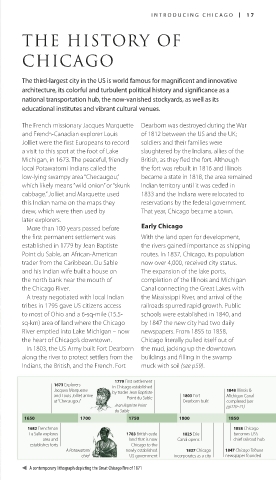
1779 First settlement
1673 Explorers in Chicago established
Jacques Marquette by trader Jean Baptiste 1848 Illinois &
and Louis Jolliet arrive Point du Sable 1803 Fort Michigan Canal
at “Checaugou” Dearborn built completed (see
Jean Baptiste Point pp120–21)
du Sable
1650 1700 1750 1800 1850
1682 Frenchman 1858 Chicago
La Salle explores 1783 British cede 1825 Erie becomes US’s
area and land that is now Canal opens chief railroad hub
establishes forts Chicago to the
A Potawatomi newly established 1837 Chicago 1847 Chicago Tribune
chief US government incorporates as a city newspaper founded
A contemporary lithograph depicting the Great Chicago Fire of 1871
016-021_EW_Chicago.indd 17 13/07/16 2:58 pm

