


Page 83 - All About History - Issue 53-17
P. 83
vi
                                                                                                                       e
                                                                                                                   r
                                                                                                            Intervieww
                                                                                                            Inte


                                                                HOW TO SPOT

                                                                 BAD HISTORY

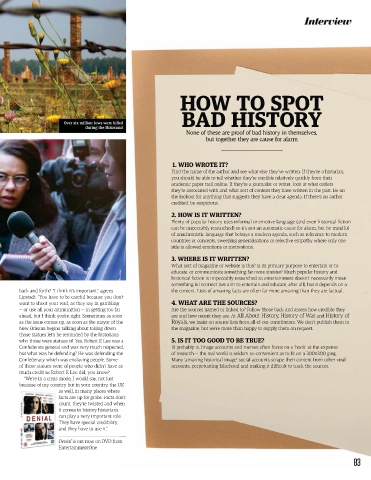
                       Over six million Jews were killed
                               during the Holocaust
                                                                  None of these are proof of bad history in themselves,
                                                                         but together they are cause for alarm


                                                              1. WHO WROTE IT?
                                                             Find the name of the author and see what else they’ve written. If they’re a historian,
                                                             you should be able to tell whether they’re credible relatively quickly from their
                                                             academic paper trail online. If they’re a journalist or writer, look at what outlets
                                                             they’re associated with and what sort of content they have written in the past. Be on
                                                             the lookout for anything that suggests they have a clear agenda. If there’s no author
                                                             credited, be suspicious.
                                                             2. HOW IS IT WRITTEN?
                                                             Plenty of popular history uses informal or emotive language (and even historical fiction
                                                             can be impeccably researched) so it’s not an automatic cause for alarm, but be mindful
                                                             of anachronistic language that betrays a modern agenda, such as reference to modern
                                                             countries or concepts, sweeping generalisations or selective empathy where only one
                                                             side is allowed emotions or motivations.
                                                             3. WHERE IS IT WRITTEN?
                                                             What sort of magazine or website is this? Is its primary purpose to entertain or to
                                                             educate, or communicate something far more sinister? Much popular history and
                                                             historical fiction is impeccably researched so entertainment doesn’t necessarily mean
                                                             something is incorrect (we aim to entertain and educate, after all), but it depends on a
        back and forth?  “I think it’s important,” agrees    the context. Lists of amazing facts are often far more amazing than they are factual.
        Lipstadt. “You have to be careful because you don
                                           n
                                            ’t
        want to shoot your wad, as they say in gambling      4. WHAT ARE THE SOURCES?
        — or use all your ammunition — in getting too far    Are the sources named or linked to? Follow those back and assess how credible they
        ahead, but I think you’re right. Sometimes as soon n   are and how recent they are. At All About History, History of War and History of
        as the issue comes up, as soon as the mayor of th he   Royals, we insist on source lists from all of our contributors. We don’t publish them in
        New Orleans begins talking about taking down         the magazine, but we’re more than happy to supply them on request.
        those statues let’s be reminded by the historians
        who those were statues of. Yes, Robert E Lee was    a   5. IS IT TOO GOOD TO BE TRUE?
        Confederate general and was very much respected,      It probably is. Image accounts and memes often focus on a ‘hook’ at the expense
        but what was he defending? He was defending th he    of research — the real world is seldom so convenient as to fit on a 300x300 jpeg.
        Confederacy which was enslaving people. Some         Many ‘amazing historical image’ social accounts scrape their content from other viral
        of those statues were of people who didn’t have a    accounts, perpetuating falsehood and making it difficult to track the sources.
                                           as
        much credit as Robert E Lee did, you know?
          “We’re in a crisis mode, I would say, not just
        because of my country but in your country, the U UK
                      as well, in many places where
                      facts are up for grabs. Facts do on’t
                      count, they’re twisted and whe en
                      it comes to history historians
                      can play a very important role   e.
                      They have special credibility,
                      and they have to use it.”
                      Denial is out now on DVD from m
                      EntertainmentOne
                                                                                                                             83 83

