


Page 86 - (DK) The Dog Encyclopedia
P. 86
CATALOG OF BREEDS  |  WORKING DOGS


           Chinese Shar-Pei


                HEIGHT        WEIGHT       LIFE SPAN          Variety of colors
                 18–20in      40–55lb      Over 10 years
                (46–51cm)     (18–25kg)


          A generally friendly temperament is hidden
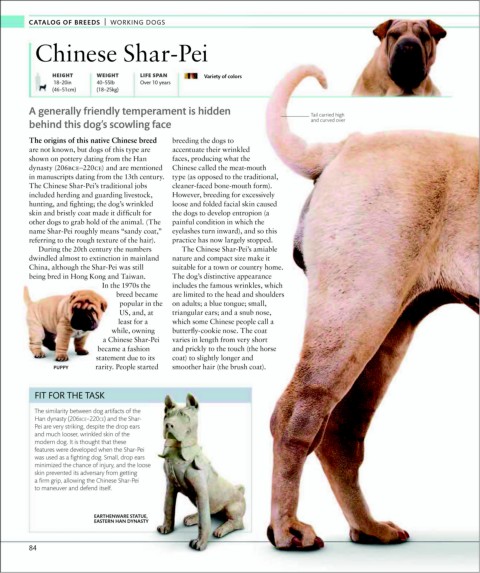
                                                                                              Tail carried high
                                                                                              and curved over
          behind this dog’s scowling face

          The origins of this native Chinese breed   breeding the dogs to
          are not known, but dogs of this type are   accentuate their wrinkled
          shown on pottery dating from the Han      faces, producing what the
          dynasty (206BCE–220CE) and are mentioned   Chinese called the meat-mouth
          in manuscripts dating from the 13th century.  type (as opposed to the traditional,
          The Chinese Shar-Pei’s traditional jobs   cleaner-faced bone-mouth form).
          included herding and guarding livestock,   However, breeding for excessively
          hunting, and fighting; the dog’s wrinkled   loose and folded facial skin caused
          skin and bristly coat made it difficult for   the dogs to develop entropion (a
          other dogs to grab hold of the animal. (The   painful condition in which the
          name Shar-Pei roughly means “sandy coat,”   eyelashes turn inward), and so this
          referring to the rough texture of the hair).  practice has now largely stopped.
             During the 20th century the numbers       The Chinese Shar-Pei’s amiable
          dwindled almost to extinction in mainland   nature and compact size make it
          China, although the Shar-Pei was still    suitable for a town or country home.
          being bred in Hong Kong and Taiwan.       The dog’s distinctive appearance
                               In the 1970s the     includes the famous wrinkles, which
                                    breed became    are limited to the head and shoulders
                                     popular in the   on adults; a blue tongue; small,
                                     US, and, at    triangular ears; and a snub nose,
                                    least for a     which some Chinese people call a
                                  while, owning     butterfly-cookie nose. The coat
                                a Chinese Shar-Pei   varies in length from very short
                              became a fashion      and prickly to the touch (the horse
                              statement due to its   coat) to slightly longer and
                 PUPPY       rarity. People started   smoother hair (the brush coat).


           FIT FOR THE TASK

           The similarity between dog artifacts of the
           Han dynasty (206BCE–220CE) and the Shar-
           Pei are very striking, despite the drop ears
           and much looser, wrinkled skin of the
           modern dog. It is thought that these
           features were developed when the Shar-Pei
           was used as a fighting dog. Small, drop ears
           minimized the chance of injury, and the loose
           skin prevented its adversary from getting
           a firm grip, allowing the Chinese Shar-Pei
           to maneuver and defend itself.


                             EARTHENWARE STATUE,
                             EASTERN HAN DYNASTY


          84

