


Page 148 - (DK Eyewitness) Travel Guide - South Africa
P. 148
146 C APE T OWN
2 Robben Island
Named “Robben Eiland” – seal island – by the Dutch in the mid- ROBBEN
17th century, Robben Island has seen much human suffering. ISLAND
As early as 1636 it served as a penal settlement, and it was taken
over by the South African Prisons Service in 1960. Its most famous
inmate was Nelson Mandela, who spent 18 years here. When the
V&A
last political prisoners were releas ed in 1991, the South African WATERFRONT
Natural Heritage Programme nominated the island for its signifi-
cance as a seabird breeding colony – it hosts more than 130 bird
species. In 1997 the island was designated a museum, and in
1999 it was declared a UNESCO World Heritage Site.
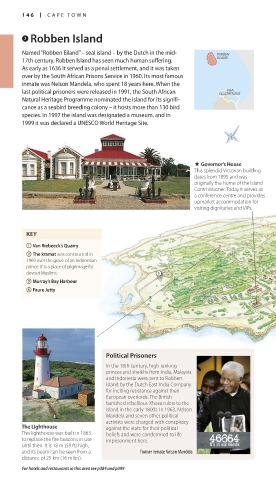
. Governor’s House
This splendid Victorian building
dates from 1895 and was
originally the home of the Island
Commissioner. Today it serves as
a conference centre and provides
upmarket accommo dation for
visiting dignitaries and VIPs.
KEY
1 Van Riebeeck’s Quarry
2 The kramat was constructed in
1969 over the grave of an Indo nesian
prince. It is a place of pilgrimage for
devout Muslims.
3 Murray’s Bay Harbour
4 Faure Jetty
Political Prisoners
In the 18th century, high-ranking
princes and sheikhs from India, Malaysia
and Indonesia were sent to Robben
Island by the Dutch East India Company
for inciting resistance against their
European overlords. The British
banished rebellious Xhosa rulers to the
island in the early 1800s. In 1963, Nelson
Mandela and seven other political
activists were charged with conspiracy
The Lighthouse against the state for their political
This lighthouse was built in 1863 beliefs and were con demned to life
to replace the fire beacons in use imprisonment here.
until then. It is 18 m (59 ft) high,
and its beam can be seen from a Former inmate Nelson Mandela
distance of 25 km (16 miles).
For hotels and restaurants in this area see p384 and p399
146-147_EW_South_Africa.indd 146 25/05/17 11:59 am

