


Page 359 - (DK Eyewitness) Travel Guide - South Africa
P. 359
THE ARID INTERIOR 357
SOUTH OF THE ORANGE
Vast and unrelenting, the great Karoo is a uniquely South African
landscape of dolerite outcrops, buttes and endless plains. In
restful towns and villages the harshness of the terrain is
softened by the large, low, sandstone homesteads, typical
of Karoo architecture. Several nature reserves and national
parks have been established to conserve the territory’s
fascinating environment and wildlife.
The indigenous Khoi called the region it became an important centre for
Karoo (“land of great thirst”) and the the surrounding community of sheep
Dutch colo nists of the 17th century were farmers. Today, it has the highest number
hesitant to venture into this forbidding of national monuments in South Africa
terrain. Ensign Schrijver was the first and is renowned for its Cape Dutch
European to explore the east ern reaches architecture. Elsewhere, the typical Karoo
of the Karoo in 1689, and by 1795 the vernac ular includes steep-roofed
Cape Colony had ex panded to include the sandstone farmhouses surrounded by
southern and eastern Karoo regions. The broad verandahs and delicate latticework.
vast plains were partitioned into sheep The Camdeboo National Park sur rounds
ranches, and large migrating herds of Graaff-Reinet on three sides, while the
springbok, hartebeest, black wildebeest, Karoo National Park lies just north of
eland and quagga were decimated Beaufort West. The Mountain Zebra
through uncontrolled hunting. Some National Park, near Cradock, is cred ited
80 years later, the quagga was extinct, with saving the Cape mountain zebra
and the large herds of Cape mountain from extinction. In the eastern Karoo,
zebra and black wildebeest had been South Africa’s largest storage reservoir,
reduced to tiny remnant populations. the Gariep Dam on the Orange River,
With the expanding frontier, several new provides water to the drought-prone
towns were established. Graaff-Reinet, Eastern Cape, and has developed into a
founded in 1786, prospered quickly as relaxing and remote lakeside resort.
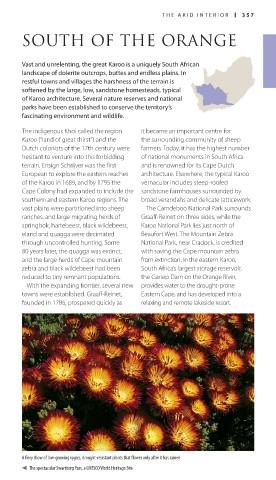
A fiery show of low-growing vygies, drought-resistant plants that flower only after it has rained
The spectacular Swartberg Pass, a UNESCO World Heritage Site
356-357_EW_South_Africa.indd 357 25/05/17 12:00 pm

