


Page 377 - (DK Eyewitness) Travel Guide - South Africa
P. 377
NOR TH OF THE OR ANGE 375
The Kimberley Diamond Rush
Kimberley Mine, or the Big Hole, as it is known, is the only one of four diamond mines
in the Kimberley area that is still open. Within two years of the discovery of diamond-
bearing kimberlite pipes in 1871, the claims were being worked by up to 30,000 miners
at a time. Early photo graphs reveal a spider’s web of cables radiating upwards from the
edge of the excavation. With little more than picks and shovels to aid them, the miners
dug deep into the earth, and by 1889, the hole had reached an astounding depth of
150 m (488 ft). The deeper the miners delved, the more difficult it became to extract
the diamond-bearing soil, and the chaotic arrange ment of cables, precipitous paths
and claims lying at varying heights encouraged the diggers to form syndicates.
These groupings were absorbed into various companies that were later acquired by
Cecil John Rhodes.
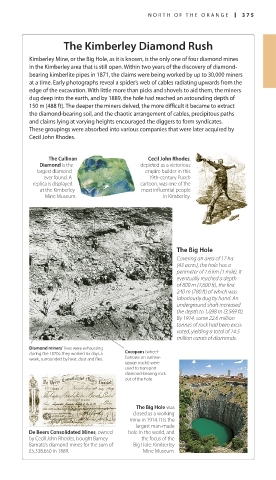
The Cullinan Cecil John Rhodes,
Diamond is the depicted as a victorious
largest diamond empire builder in this
ever found. A 19thcentury Punch
replica is displayed cartoon, was one of the
at the Kimberley most influential people
Mine Museum. in Kimberley.
The Big Hole
Covering an area of 17 ha
(43 acres), the hole has a
perimeter of 1.6 km (1 mile). It
eventually reached a depth
of 800 m (2,600 ft), the first
240 m (780 ft) of which was
laboriously dug by hand. An
underground shaft increased
the depth to 1,098 m (3,569 ft).
By 1914, some 22.6 million
tonnes of rock had been exca
vated, yielding a total of 14.5
million carats of diamonds.
Diamond miners’ lives were exhausting
during the 1870s: they worked six days a Cocopans (wheel
week, surrounded by heat, dust and flies. barrows on narrow
gauge tracks) were
used to transport
diamondbearing rock
out of the hole.
The Big Hole was
closed as a working
mine in 1914. It is the
largest manmade
De Beers Consolidated Mines, owned hole in the world, and
by Cecil John Rhodes, bought Barney the focus of the
Barnato’s diamond mines for the sum of Big Hole: Kimberley
£5,338,650 in 1889. Mine Museum.
374-375_EW_South_Africa.indd 375 25/05/17 2:48 pm

